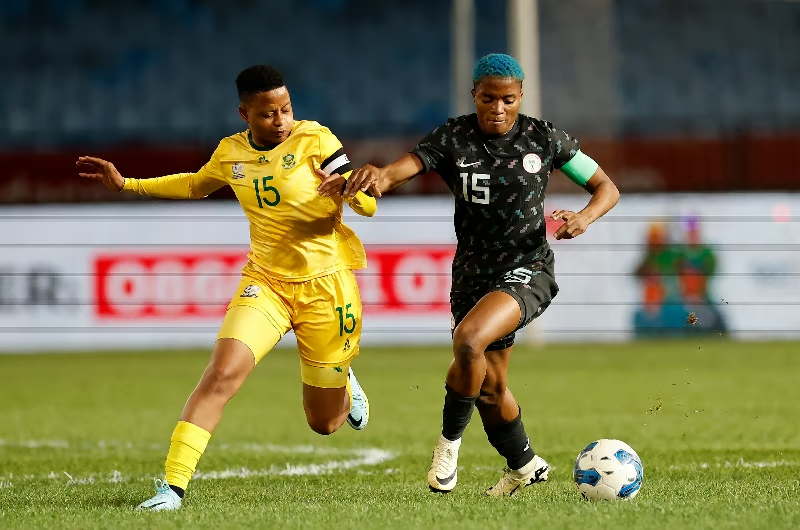
The Stade Moulay Rachid in Casablanca will host one of the most consequential meetings in recent African women’s football on Thursday, August 13, when Nigeria and South Africa meet in the WAFCON 2026 play-in round with a place in the 2027 FIFA Women’s World Cup inter-confederation playoffs at stake. Kickoff is scheduled for 9pm Nigerian time.
Only days ago, both teams were preparing for the possibility of fighting for the WAFCON title and securing their World Cup ambitions through the main tournament route. Instead, quarterfinal defeats to Cameroon and Morocco have pushed them into an unfamiliar position: one more loss and the road to Brazil 2027 ends.
That makes this more than another chapter in one of African football’s great rivalries. It is a second chance, and one neither side can afford to waste.
Why this match matters
Nigeria entered the 2026 WAFCON as defending champions and the most successful nation in the history of the competition, but their title defence ended abruptly with a 1-0 defeat to Cameroon.
The Super Falcons had enough possession and opportunities to change the outcome, finishing with 19 attempts and nine shots on target, but Maéva Nyadjou’s 19th minute goal proved decisive.
The defeat also meant Nigeria could no longer qualify automatically for the 2027 World Cup through their WAFCON position.
South Africa experienced a similar disappointment. The Banyana Banyana were beaten 2-1 by hosts Morocco after Sakina Ouzraoui Diki and Hanane Ait El Haj gave the North Africans a two-goal advantage.
Thembi Kgatlana pulled one back in the 67th minute, but South Africa could not find the equaliser that would have kept their title ambitions alive.
The consequence is that two teams who expected to be competing for continental silverware are now fighting simply to remain in the World Cup qualification race.
The winner in Casablanca will advance to the inter-confederation playoff tournament, keeping their hopes of reaching Brazil 2027 alive. The loser will be eliminated from the qualification pathway.
For Nigeria, there is an additional piece of history at stake. The Super Falcons have appeared at every edition of the Women’s World Cup since the tournament began, and defeat would bring that remarkable sequence dangerously close to an end.
Current form
Nigeria’s WAFCON campaign has been a mixture of resilience, attacking quality and frustrating inconsistency.
The Super Falcons began the tournament with a 3-2 defeat to Malawi, immediately placing pressure on their title defence. They responded impressively, beating Zambia before producing one of their most convincing performances of the tournament in a 6-2 demolition of Egypt.
That momentum appeared to carry into the quarterfinal against Cameroon. Nigeria controlled significant periods of the contest and repeatedly threatened the Cameroonian goal, but their dominance did not translate into the one thing that mattered most: a goal.
The problem was not simply the number of chances created. It was the quality of the final decision and the inability to turn promising situations into a decisive moment.
South Africa’s route to the quarterfinals was steadier, but their campaign ended with the same frustration.
Desiree Ellis’ side pushed Morocco hard and showed enough attacking quality to remain in the contest after falling two goals behind. Kgatlana’s strike demonstrated the danger Banyana still possess in the final third, but the eventual 2-1 defeat left them facing the same uncomfortable reality as Nigeria.
Neither side needs to be reminded of what happened in the quarterfinals. Both now have 90 minutes to make sure it does not happen again.
Historical context
The history between Nigeria and South Africa stretches back more than three decades and has traditionally been dominated by the Super Falcons.
Across 26 recorded meetings, Nigeria have won 17, drawn six and lost only three, scoring 50 goals compared with South Africa’s 18. The early years were particularly one-sided, with Nigeria recording victories such as 4-1 and 7-1 in their first two meetings in 1995.
The Super Falcons subsequently added emphatic victories including a 2-0 win at the 2000 WAFCON, a 5-0 triumph in 2002, a 3-0 friendly victory in 2003 and a 5-0 Olympic qualifying win in 2008.
But the rivalry has changed. South Africa’s rise has narrowed the historical gap considerably, with Banyana claiming their first WAFCON victory over Nigeria in 2012 before repeating the feat in 2018.
They also defeated Nigeria 4-2 at the 2021 Aisha Buhari Cup and won 2-1 at the 2022 WAFCON.
The recent record illustrates the transformation even more clearly. Across the last five meetings, Nigeria and South Africa have won two each, while the other match ended in a draw.
Nigeria, however, enter this contest with the psychological boost of their most recent victory. The Super Falcons defeated Banyana Banyana 2-1 in the 2025 WAFCON semi final, with Michelle Alozie scoring a dramatic added-time winner in Casablanca.
That result will be fresh in the memories of both camps, but so will South Africa’s ability to hurt Nigeria in recent encounters.
Key battle: Nigeria’s attack vs South Africa’s transitions
The central contest may be decided by what happens when Nigeria have the ball. the Super Falcons are likely to assume the initiative, particularly because they cannot afford to approach the game with the same passive acceptance that a draw might encourage.
They need to create, attack and eventually score. that creates the first major tactical problem.
South Africa possess the pace and movement to punish Nigeria when possession is lost. Thembi Kgatlana remains the obvious danger, while Hildah Magaia and Jermaine Seoposenwe offer further movement capable of stretching a defence that commits players forward.
Nigeria therefore need to attack without becoming reckless. Rasheedat Ajibade will be central to that balance. Her ability to connect midfield with attack gives the Super Falcons a player capable of breaking defensive lines.
while Toni Payne and Uchenna Kanu can provide width and movement around the South African defensive block.
Asisat Oshoala also offers a different dimension through her experience, physical presence and ability to attack spaces around the centerbacks.
The challenge is making sure those qualities are converted into chances of sufficient quality.
Nigeria produced 19 shots against Cameroon and still left the field without scoring. Against South Africa, possession without penetration could become another route to disappointment.
Tactical angle
Madugu’s biggest tactical task is finding the right balance between attacking urgency and defensive security.
Nigeria cannot afford to spend long periods circulating the ball without moving South Africa’s defensive structure. Banyana have enough discipline to frustrate possession-heavy opponents, while their speed in transition means every misplaced pass could potentially become an attacking opportunity at the other end.
The Super Falcons will need quicker combinations, more intelligent movement between the lines and better use of the wide areas to pull South Africa’s defence apart.
Ajibade’s positioning could be particularly important because Nigeria need someone capable of receiving between the lines rather than simply moving the ball from side to side.
There is also a strong argument for greater midfield energy.
Deborah Abiodun’s physicality alongside Christy Ucheibe or another disciplined central midfielder could help Nigeria protect against South African transitions while allowing Ajibade to operate further forward. The objective should be to win the ball back quickly without leaving the defence exposed.
South Africa, meanwhile, may be comfortable allowing Nigeria to have possession.
Ellis’ team have demonstrated that they can compete without dominating the ball, and the presence of Kgatlana and Magaia means they do not necessarily need long periods of possession to create danger.
That could turn the match into a test of patience for Nigeria. the longer the Super Falcons go without scoring, the greater the temptation will be to commit more players forward. South Africa will be waiting for precisely that moment.
Predicted lineups and team news
Nigeria are expected to retain much of the core that started against Cameroon, with Chiamaka Nnadozie continuing in goal and Michelle Alozie, Blessing Demehin, Osinachi Ohale and Shukurat Oladipo providing the defensive structure.
Ajibade should again occupy an influential role in midfield, while Payne and Kanu offer attacking options from the wide areas. Oshoala remains one of Madugu’s most experienced options in the final third, although Gift Monday and Esther Okoronkwo are among the players capable of changing the attacking dynamic if required.
There have been no major new injury concerns publicly reported from the Nigerian camp.
Nigeria (4-2-3-1): Nnadozie; Alozie, Demehin, Ohale, Oladipo; Abiodun, Ucheibe; Payne, Ajibade, Kanu; Oshoala.
South Africa also have an experienced core available to Ellis, with Kaylin Swart expected to continue in goal and captain Refiloe Jane providing leadership in midfield.
Kgatlana will be the obvious attacking threat after scoring against Morocco, while Magaia and Seoposenwe offer movement and pace around her.
South Africa (4-3-3): Swart; Dhlamini, Mbane, Gamede, Motau; Jane, Motlhalo, Cesane; Kgatlana, Magaia, Seoposenwe.
Numbers that matter
Nigeria have dominated the overall rivalry, winning 17 of their 26 recorded meetings with South Africa, while Banyana have won three and six have ended in draws.
The Super Falcons have also scored 50 goals in those encounters, compared with South Africa’s 18, underlining the scale of Nigeria’s historical advantage.
That dominance has become considerably less pronounced in recent years, with the last five meetings producing two wins for each side and one draw.
Nigeria’s most recent victory came at the 2025 WAFCON, when they defeated South Africa 2-1 in the semi-final.
The Super Falcons also won 1-0 against Banyana in an Olympic qualifying match in April 2024, although South Africa had previously beaten Nigeria 2-1 at the 2022 WAFCON.
Nigeria’s quarter-final defeat to Cameroon exposed a particularly important statistic: despite registering 19 shots and nine attempts on target, the Super Falcons failed to score.
The team had also conceded six goals across their four WAFCON matches before this play-in, including three against Malawi, two against Egypt and one against Cameroon.
South Africa, meanwhile, scored against Morocco through Kgatlana after falling two goals behind, meaning they have already demonstrated their ability to respond when placed under pressure during this tournament.
What the managers are saying
The mood around both camps has been shaped by the knowledge that there is no further safety net after this match.
Madugu has described the fixture as a second opportunity for his players and insists Nigeria will do everything possible to take advantage of it.
“We have a second chance. We have this second opportunity. We are still going to do the best that we can.”
The Nigeria coach has also made it clear that selection will be based on who he believes can deliver victory rather than simply rotating the squad.
Ajibade has echoed that determination, urging her teammates to put the Cameroon disappointment behind them.
“What has happened has happened. There’s nothing we can do about that. We can’t control it anymore.”
The captain understands the wider significance of the fixture, particularly given Nigeria’s extraordinary record at the Women’s World Cup.
“Sometimes champions are defined in the face of adversities.”
South Africa coach Ellis is approaching the match with a similar sense of urgency.
“We obviously have to bring our A game…there’s no margin for error.”
Her description of Nigeria and South Africa as the “two big guns of Africa football” captures the scale of the rivalry, but the stakes make Thursday’s meeting different from the encounters that came before it. this time, there is no next match for the loser.
READMORE: Malawi, Cameroon reach WAFCON final after historic semifinal triumphs
Final thought
There is something unusual about the circumstances surrounding this meeting. Nigeria and South Africa are not supposed to be fighting for survival at this stage of a major African tournament.
They are two of the continent’s most established women’s football powers, teams accustomed to reaching the latter stages of WAFCON and competing for World Cup places.
Yet the quarter final defeats have created a contest in which reputation means very little. Nigeria’s history is superior, but South Africa have spent the past decade demonstrating that they are capable of challenging that hierarchy.
The Super Falcons have the greater depth of attacking options, while Banyana possess enough pace and technical quality to punish Nigeria if the game becomes stretched.
The challenge for Madugu is therefore not simply to make Nigeria attack more. It is to make them attack better.
The Cameroon defeat showed what happens when dominance is not converted into goals. Against South Africa, the Super Falcons must be more clinical, more patient when faced with a compact defence and more disciplined when possession is lost.
The winner will not qualify directly for the 2027 World Cup. Instead, victory in Casablanca will buy another opportunity through the inter-confederation playoffs.
But that opportunity is everything. it could preserve a World Cup record that has stood since 1991. For South Africa, it offers another route towards a tournament they desperately want to reach.
Three decades of rivalry have produced 26 meetings, 68 goals and countless twists but Thursday’s meeting may produce the most important one yet.
TheAthleticNG Prediction: Nigeria 1-0 South Africa
Nigeria’s attacking depth, experience and superior historical record give the Super Falcons a narrow edge, but South Africa’s pace in transition should make this a difficult contest. The expectation is for Banyana Banyana to create dangerous moments, particularly if Nigeria become too aggressive, but the Super Falcons should have enough quality to eventually find the decisive moments and keep their World Cup dream alive.