
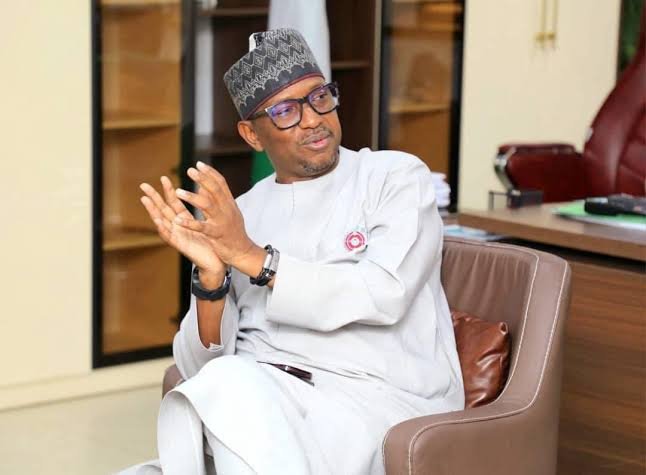
For more than a decade, the 2010 Statutes provided the framework through which the Nigeria Football Federation was governed. By March 2026, however, National Sports Commission Chairman Shehu Dikko believed the document had outlived its usefulness.
Addressing the NFF Extraordinary General Assembly in Yenagoa on March 23, Dikko delivered an unusually direct assessment of the federation’s governing framework.
“The 2010 NFF Statutes has become obsolete. It is no longer fit for purpose, it does not reflect modern governance standards, it does not sufficiently guarantee inclusivity or balanced stakeholder participation, and it does not align with the current direction of sports governance in Nigeria as envisioned or with evolving global best practices.”
It was a significant intervention because the issue was not merely the age of the document.
The deeper question was who gets to participate in the governance of Nigerian football and how much voting power each constituency possesses.
first, what exactly was the 2010 framework?
The 2010 NFF Statutes were adopted after an Extraordinary General Assembly in Abuja on December 29, 2009, and came into effect on January 5, 2010.
Among the most contentious features of the framework was the composition of the NFF Congress, the federation’s highest decision making body.
Under the previous structure, the 36 State Football Associations and the Federal Capital Territory together controlled 37 of the 44 votes in the Congress.
That meant one constituency effectively held about 84.1 per cent of the entire voting power and the remaining votes were distributed among representatives of other football constituencies, including the referees, players, coaches and the country’s leagues.
Contemporary reporting has consequently described the arrangement as heavily concentrated in favour of the State FAs.
That concentration became a recurring point of debate among stakeholders who believed the structure did not adequately reflect the wider football family.
The argument was not that State Football Associations should have no voice rather, critics questioned whether one constituency should possess such a dominant share of the national federation’s electoral power.
here’s Why Dikko called the system outdated
Dikko’s objection went beyond the voting arithmetic. He argued that Nigerian football had changed dramatically since 2010 and that its governance structure had failed to keep pace.
“What may have seemed adequate in 2010 has clearly become inadequate for Nigerian football in 2026 and beyond. The game has evolved, governance expectations have changed, and Nigeria itself has moved forward.”
His solution was a comprehensive reform process rather than a cosmetic adjustment.
Dikko called for the meaningful representation of players, clubs, leagues, referees, coaches and administrators, while also demanding stronger standards of transparency, accountability and integrity.
That was significant because the modern football industry is much broader than the traditional administrative structures that dominated the game more than a decade ago.
REDMORe: “The system must correct itself” – How Shehu Dikko warned NFF five months before it self-destructed
Football now involves major commercial rights, broadcasting, sponsorship, digital content, merchandising, player development and increasingly sophisticated club ownership models.
Dikko therefore wanted the governance structure to reflect those realities.
The reform had already begun
There is an important twist to the story. The same Extraordinary General Assembly at which Dikko criticised the old framework also approved amendments to the NFF’s governing documents.
The Congress unanimously approved amendments to the NFF Statutes, Electoral Code and Standing Orders of the General Assembly, while also fixing September 26, 2026 for the elective congress.
In other words, Dikko was not simply making a theoretical demand for change. The NFF Congress took a step towards changing the rules during that same meeting.
The significance of the amendments becomes clearer when viewed against the previous electoral structure.
Under the old arrangement, the 37 State FA/FCT representatives accounted for 37 of 44 votes.
The revised framework increased the total voting structure to 54 votes, according to subsequent reporting, while broadening representation across different parts of the football family.
The State FA/FCT bloc therefore remained highly influential, but its numerical dominance was reduced from approximately 84 per cent of the old electorate to about 68.5 per cent of the revised voting structure.
That is an important distinction. The reform did not simply eliminate the influence of State Football Associations, Instead, it changed the balance by expanding the overall structure.
Why representation matters
The debate over the NFF Statutes is ultimately a debate about representation. Nigeria’s football ecosystem contains players, coaches, referees, clubs, leagues, administrators and grassroots organizations.
If one constituency possesses overwhelming control of the electoral process, critics argue that the interests of the other constituencies may struggle to carry comparable weight.
A 2024 analysis of the 2010 framework, for example, highlighted the apparent contradiction between the Statutes’ recognition of five federating units and the concentration of voting rights in the State Football Associations.
The issue has also featured in legal and institutional disputes around the NFF’s governance structure, demonstrating that the controversy did not begin with Dikko’s March 2026 intervention.
It is therefore important to understand Dikko’s criticism as part of a longer-running debate about how Nigerian football should be governed.
Dikko wanted more than a new election formula
Changing the voting structure was only one part of the bigger picture, The NSC chairman wanted Nigerian football’s governing institutions to become more transparent, inclusive and economically productive.
The reform, he said, should encourage private sector participation and unlock investment opportunities around football’s commercial rights.
That includes broadcasting, sponsorship, digital content and merchandising. his argument was that football governance should no longer be concerned solely with administering competitions and national teams.
It should also be concerned with creating economic value.
“Football governance must now be designed not only to administer the game, but to grow its economic value as well as ensure its sustained competitiveness and success on the pitch.”
The bigger question for Nigerian football
The 2010 Statutes may have governed Nigerian football for 16 years, but the debate over them ultimately points to a much larger question.
What should Nigeria’s football governance system look like in the modern era?
The answer cannot simply be about who occupies the NFF presidency.
It is about how those leaders emerge, who gets to vote for them, how different football constituencies are represented and whether the structure encourages competence, accountability and commercial growth.




































Pingback: Dikko: Tinubu govt gave NFF over 200% more support in 2½ years than previous govt gave in 8 - so what went wrong? - The Athletic NG