Nigeria Football Federation president Ibrahim Musa Gusau has raised concerns over the increasing movement of promising Nigerian youth players to foreign clubs, warning that the trend is creating fresh challenges for the country’s national team development system.
Gusau made the observation while discussing the difficulties faced by Nigeria in retaining home-based talents during an assessment of the country’s football development landscape.
According to the NFF president, Nigerian players are increasingly being identified by foreign clubs and scouts at younger ages, meaning that talents who enter the national-team system can leave the country before coaches have enough time to develop them within the domestic structure.
Gusau said the growing international interest in Nigerian players is evidence of the quality available within the country’s youth football system.
Rather than suggesting that the movement of talented players abroad is entirely negative, he acknowledged that it reflects the strong reputation Nigerian footballers continue to enjoy internationally.
The concern, however, is what the early departures mean for Nigeria’s domestic development structure and the ability of national-team coaches to work with players over an extended period.

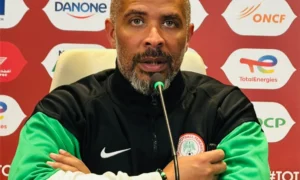
Nigeria Football Federation president Ibrahim Musa Gusau.
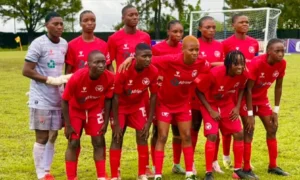
Gusau pointed specifically to Nigeria’s youth teams, noting that several players involved during the qualification process had subsequently moved abroad to begin professional careers.
“Most of these countries believe in the product of Nigeria. They believe in the talent and the strength of Nigerian players.”
That growing demand has created something of a paradox for Nigerian football.
The country continues to produce players capable of attracting European and international attention, but the same talent pipeline can be weakened when promising youngsters leave before domestic clubs and national-team structures have fully benefited from their development.
Youth national teams increasingly affected
The issue is particularly relevant to Nigeria’s age-grade teams, where the identification and development of players are closely connected to the domestic football system.
A youngster discovered through a local academy or youth competition can quickly attract attention from scouts and clubs outside Nigeria.
Once that player moves abroad, national team coaches may have less control over his or her development, while the domestic ecosystem loses a potentially important player.
Gusau suggested that this is becoming increasingly common and is not limited to one section of Nigerian football.
The trend affects both male and female players, with foreign clubs increasingly searching for Nigerian talent at younger ages.
Nigeria’s talent drain extends beyond the domestic game

National Sports Commission chairman Shehu Dikko
The concerns raised by Gusau also connect with a broader question confronting Nigerian football, how can the country benefit from the enormous pool of talent that exists both at home and within the diaspora?
The National Sports Commission has recently placed greater emphasis on addressing that question through its Nigeria Diaspora Talents Development Committee.
NSC chairman Shehu Dikko has argued that Nigeria can no longer afford to watch players of Nigerian heritage develop elsewhere before ultimately representing other countries.
His comments came during the launch of the committee’s multi-sport talent development initiative in the United Kingdom.
Dikko identified players such as Bukayo Saka, Eberechi Eze and Michael Olise as examples of the type of Nigerian-heritage talent the country could potentially have integrated into its national teams through earlier and more structured engagement.
“If we had done what we are doing now long ago, maybe the likes of Michael Olise, Bukayo Saka and Eberechi Eze would be playing for Nigeria today.”
The initiative is a different side of the same problem highlighted by Gusau.
While the NFF president is concerned about promising players leaving Nigeria, the NSC is attempting to ensure that Nigerian players born or developed abroad do not become permanently disconnected from the country.
The diaspora could become part of the solution

Olopade says Nigeria could have won World Cup with diaspora players. Photocredit: NSC/X
Dikko has argued that Nigeria must build a system capable of identifying Nigerian talent wherever it is located rather than relying solely on players developed within the country’s domestic structure.
The NSC chairman pointed to Morocco’s recent success as evidence of the potential benefits of a properly organised diaspora strategy.
According to Dikko, Morocco’s rise has been supported significantly by players developed outside the country who were subsequently integrated into its national-team structure.
“So the renaissance you are seeing from Morocco is actually from the diasporans.”
The argument is that Nigeria possesses a similar advantage but has historically lacked the structures needed to maximise it.
That is why the new diaspora programme is being positioned not simply as a recruitment exercise but as part of a wider talent-development strategy.
The objective is to identify Nigerian-heritage athletes early, establish relationships with them and create pathways that could eventually lead to international representation.
Nigeria must stop allowing talent to strengthen rivals
NSC director general Bukola Olopade has made a similar argument, insisting that Nigeria’s global talent pool is too large to continue losing players to other national teams.
Speaking at the same diaspora development event, Olopade said the Federal Government had mandated the commission to search for athletes of Nigerian origin across the world.
He argued that the country must move beyond simply appealing to diaspora players to choose Nigeria and instead create an environment that makes representing the country an attractive proposition.
“We want to take care of our children from a very young age to elite sports.”
Olopade also stressed that Nigeria’s responsibility should extend beyond recruitment.
The country must develop a system that identifies promising athletes early, supports their progression and gives them confidence that their sporting ambitions can be achieved while maintaining a connection with Nigeria.
That approach could become increasingly important as more Nigerian youngsters leave the domestic system for professional opportunities abroad.
READMORE: Galatasaray reject Al-Hilal approach for Victor Osimhen
The movement of young Nigerian players to foreign clubs is not necessarily a problem in itself.
For many youngsters, moving abroad can provide access to better facilities, coaching, competition and professional opportunities that may not yet be consistently available within Nigeria.
The bigger question is whether Nigeria can develop mechanisms to ensure that those departures do not translate into a permanent loss for the national football structure.
That means strengthening domestic academies and youth competitions, improving the transition from age-grade football to senior football and maintaining effective relationships with Nigerian players once they move abroad.
It also means ensuring that the national team system can identify eligible players early enough, whether they are developing in Lagos, Enugu, London, Manchester, Paris or elsewhere.
CLICK HERE TO JOIN ATHLETIC NG WHATSAPP CHANNEL NOW!