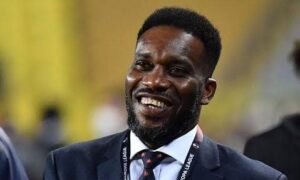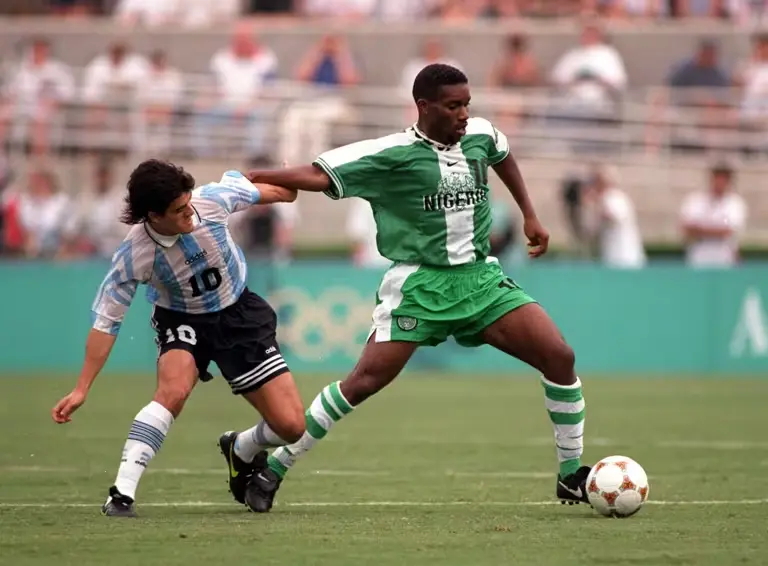
For more than three decades, the name Jay-Jay Okocha has been one of the most recognizable identities in African football, but the Nigerian legend has revealed that the name which became synonymous with his dazzling career was not originally his at all.
Okocha explained that “Jay-Jay” was a nickname created by his brother James during their childhood, long before the name became familiar to football supporters around the world.
The revelation came during the latest episode of the Obi-One Podcast, where former Super Eagles captain John Obi Mikel asked Okocha about the origins of the name that has followed him from the streets of Nigeria to some of the biggest stages in world football.
Okocha traced its beginnings to the neighborhood where he grew up, where football was not simply a pastime but a central part of everyday life.
“All of us were footballers because we had no other toy,” he explained. “We were just on the street playing.”
With Okocha and his brothers all playing football and several members of the family sharing the name Austin, those around them needed a way to distinguish between the siblings.
That was where James came in.
“We had a few Austin then, so that to identify which Austin is which, they started calling me Austin JJ’s brother,” Okocha recalled.
The description eventually became “Austin Jay-Jay”, and from there, the nickname simply stuck.
READMORE: NSC halts NFF election plans as normalisation committee looms
Its usefulness became even more apparent when Okocha travelled outside Nigeria and encountered a problem that had nothing to do with football. People struggled to pronounce Augustine, his given name, while Jay-Jay was considerably easier.
“When I travelled, some people were struggling to pronounce my name, Augustin. So, Jay-Jay was a lot easier,” he said.
Rather than constantly correcting people, Okocha decided to embrace the name that had already become part of his identity.
“So, I said, I might as well adopt the name,” he explained.
But the story did not stop at football fans and teammates calling him Jay-Jay. Okocha revealed that he eventually went a step further by adding the name officially, revealing that he eventually added Jay-Jay to his passport.
“And I put it in my passport,” he said.
Mikel was surprised by the revelation, asking whether that meant the nickname had officially become his name.
“Yes, in my passport. Officially it’s mine,” Okocha replied.
The admission prompted Mikel to reveal that he had gone through a remarkably similar experience with his own name.
The former Chelsea and Super Eagles midfielder recalled that when his shirt was being prepared for the 2014 World Cup, he had given the name Michael, only for the name “Mickey” to appear instead.
“I changed my name,” Mikel said. “You know, during my U17 days, when they went to print the name, I gave them Michael, they came back with Mikel.”
Rather than viewing the mistake as a problem, Mikel decided that the unexpected version actually suited him.
“And Mikel sounds better than Michael. I had a fantastic tournament. I was like, you know what, I’m just going to keep it.”
Like Okocha, Mikel eventually made the name official by putting it in his passport.
The two stories provided an amusing connection between two generations of Super Eagles stars, but Okocha had the final word when Mikel marveled at how a nickname had become his legitimate identity.
“But I still pay royalty to my brother,” Okocha said.
That final line neatly brought the story back to where it began: with James and the childhood nickname that was never supposed to become one of the most famous names in African football.
CLICK HERE TO JOIN ATHLETIC NG WHATSAPP CHANNEL NOW!
What started as a practical way of distinguishing one Austin from another in a neighborhood full of football playing brothers eventually became the name under which Okocha built his global reputation.
Jay-Jay along the line built a reputation for extraordinary skill, creativity and an ability to entertain.
His career took him through clubs including Eintracht Frankfurt, Fenerbahce, Paris Saint-Germain, Bolton Wanderers and Qatar SC, while his performances for Nigeria made him one of the country’s most celebrated players.