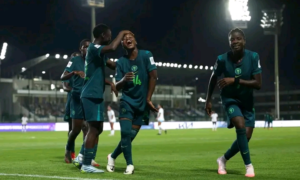
Nigeria’s Flamingos have made history by reaching their first-ever FIFA U-17 Women’s World Cup final after producing a superb second-half performance to defeat Brazil 3-1 in Wednesday’s semi final in Rabat, Morocco.
After a cautious opening period in which neither side could find a breakthrough, the Nigerian youngsters took control following the restart. Queen Joseph opened the scoring before Awawu Bashiru struck twice to put the South Americans under severe pressure.
Brazil eventually found a late response through Greise Kelly, but the goal could not change the outcome as the Flamingos held on for a memorable victory at the Mohammed VI Football Complex.
The achievement carries significance beyond Nigeria. The Flamingos have become the first African team to reach the final of the FIFA U-17 Women’s World Cup, giving the continent a historic opportunity to compete for the title. They will now face Japan on Saturday, November 7, with a chance to become the first African nation to win the competition.
The opening 45 minutes showed the importance of the occasion, with both teams approaching the contest carefully. Brazil arrived unbeaten after five matches and with an impressive attacking record, while Nigeria had built their campaign around defensive organisation, collective discipline and timely contributions in the final third.
The contrasting strengths identified before the match were evident from the start. Brazil looked to use their technical quality and attacking movement, but Nigeria were determined not to give Rilany’s side the space to establish their usual rhythm.
READ MORE: Nigeria’s U20 AFCON hopes revived after reported change to hosting status
The Flamingos gradually grew into the contest and looked for openings through their forward players. Queen Joseph, Mary Dunstan, Kanyinsola Yusuf, Oluwakemi Adegbuyi, Oluebube Umejiaku and Favour Nkwocha all attempted to trouble the Brazilian goal, while Pepe offered a threat at the other end.
Neither team, however, could turn those opportunities into a goal before the interval. The sides went into half time locked at 0-0, leaving the semi-final delicately balanced.
Brazil had scored 17 goals in their previous five matches, but Nigeria had conceded only four over the same period. The first half suggested that the Flamingos’ defensive discipline would make it difficult for the South Americans to reproduce their earlier attacking numbers.
Nigeria needed to find a way to turn that defensive control into a greater threat going forward. They did exactly that after the restart.
The breakthrough arrived in the 56th minute, just 11 minutes into the second half.
Oluwakemi Adegbuyi provided the assist for Queen Joseph, who finished to give Nigeria a 1-0 lead and send the Flamingos into celebration.
Joseph marked the important moment with the familiar ‘Siuuu’ celebration, but the significance of the goal went far beyond the moment of joy. Nigeria had taken the lead against an unbeaten Brazil side and placed themselves within touching distance of a first-ever appearance in the final.
The goal also forced Rilany’s team to reconsider their approach. Brazil could no longer afford to remain as cautious, and the need to find an equaliser threatened to create more space for Nigeria to exploit.
The Flamingos continued to press for another goal rather than simply retreating to protect their advantage. In the 62nd minute, Mary Dunstan tested Brazilian goalkeeper Nathy, who produced another important save to keep her team in the contest.
Nigeria were growing in confidence, and their attacking intent would soon produce an even bigger reward.
READ MORE: Super Eagles suffer fresh injury blow ahead of Tanzania as player undergoes hip operation
The Flamingos doubled their advantage in the 71st minute through Awawu Bashiru.
Queen Joseph, who had opened the scoring, turned provider by setting up Bashiru for a fine finish that made it 2-0. It was another decisive moment for Nigeria, who were now putting Brazil under serious pressure.
The goal was particularly damaging for a Brazilian side that had shown an ability to recover from difficult situations earlier in the tournament. They had fought back against Poland in the Round of 16 before advancing on penalties, and had also overturned a deficit against China PR in the quarter-final.
But Nigeria were not giving them the opportunity to repeat those comebacks.
Bashiru struck again in the 80th minute, converting an opportunity created by Oluebube Umejiaku to extend the lead to 3-0. Her second goal of the evening gave the Flamingos a commanding advantage and left Brazil with an enormous task in the closing stages.
The midfielder’s brace was the defining contribution of a remarkable second-half performance. Nigeria had entered the semi final knowing they needed to limit Brazil’s attacking influence, but they had now produced three goals against a team that had scored 17 times on its way to the last four.
Greise Kelly responds, but Brazil cannot stop Nigeria
Brazil eventually found a way through in the 89th minute, with Greise Kelly reducing the deficit after receiving an assist from Yasmin Queiroz.
The goal carried particular significance because Kelly had been one of the outstanding players of the tournament. Before the semi-final, she had registered three goals and five assists, giving her eight direct goal contributions. Her five assists were the highest at Morocco 2026, and she had been involved in almost half of Brazil’s goals.
Nigeria had identified her creative influence as one of the biggest threats they needed to contain. Although she managed to get on the scoresheet late in the contest, her contribution was not enough to rescue Brazil.
The late goal gave the South Americans something to celebrate, but the Flamingos remained in control and saw out the closing moments to secure a 3-1 victory.
For Brazil, it was the end of an unbeaten campaign and another semi-final disappointment after their fourth-place finish at the 2025 edition. It was the beginning of a new chapter for Nigeria in the history at the competition.
Japan await Nigeria in historic final
Nigeria’s reward is a place in Saturday’s final, where they will meet Japan, who also had to negotiate a difficult semi-final against defending champions DPR Korea.
Japan progressed after a 1-1 draw in regulation time before winning the penalty shoot-out 4-1, setting up a meeting with the Flamingos for the championship.
The final will offer Nigeria an opportunity to go beyond the bronze medal they won at India 2022. On that occasion, the Flamingos reached the semi-finals but lost to Colombia before defeating Germany in the third-place match. They had never previously reached the championship game.
Akeem Busari’s side have now moved beyond that barrier, and the manner of their victory over Brazil will give them confidence heading into the final.
Their journey in Morocco has demanded resilience. Nigeria began with a 2-1 defeat to Poland in the group stage, a result that threatened to complicate their campaign.
They responded with victories over Puerto Rico and defending champions DPR Korea, before eliminating Mexico and Venezuela in the knockout rounds.
The 3-1 win over Brazil represents their most significant achievement yet. It also underlines how much the team have grown since that opening setback, combining defensive discipline with greater attacking confidence as the tournament has progressed.
Japan will provide another demanding examination, but Nigeria have already earned their place among the two best teams in the competition.
The Flamingos are now one match away from a world title, and victory on Saturday would make them the first African champions in the history of the FIFA U-17 Women’s World Cup.
After years of coming close to the final, Nigeria have finally crossed the semi-final barrier. The challenge now is to make history one more time.