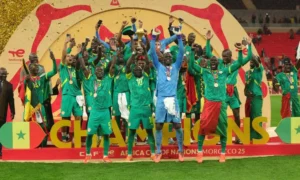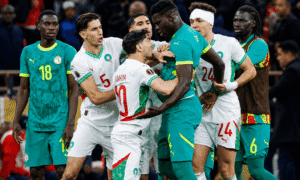
Senegal’s fight to retain their Africa Cup of Nations title has ended in victory, but the Court of Arbitration for Sport’s decision hinged on a crucial question about the authority of the referee during the controversial final against Morocco.
Could Senegal be declared to have forfeited a match that the referee had allowed to resume and finish?
That question sat at the heart of the legal battle. On Tuesday, November 24, CAS unanimously upheld Senegal’s appeal, cancelled CAF’s Appeal Board decision and restored the earlier ruling of its Disciplinary Board.
Senegal therefore remain the AFCON 2025 champions after their 1–0 victory over Morocco on January 18.
What Senegal and Morocco argued
Senegal’s central argument was that the referee, Jean-Jacques Ndala Ngambo, had the authority to decide whether the match should continue or stop.
The federation maintained that once the referee restarted the game, with both teams back on the pitch, his decision should be respected.
Morocco disagreed. Its football federation argued that Senegal had breached Articles 82 and 84 of the AFCON regulations by leaving the field without the referee’s authorisation.
It maintained that the incident justified a forfeit and challenged the referee’s decision to allow the final to continue.
Why CAS ruled in Senegal’s favour
CAS placed the referee’s authority at the centre of its judgment.
The panel concluded that the decision to restart or stop the match belonged to the referee. Both teams had returned to the pitch and expressed their willingness to continue before he restarted play.
CAS stated:
“The referee’s decision to resume the match or to stop it fell definitively within his sole authority. By blowing his whistle to restart play, the referee considered that the conditions for resuming the match had been met — both teams were on the pitch again, and both expressed their willingness to resume.”
The panel also determined that the referee’s decision was protected by football’s field of play doctrine, which generally prevents decisions made by match officials during a game from being overturned through subsequent legal challenges.
The court then addressed Articles 82 and 84, which had formed the basis of CAF’s decision to award Morocco the match.
CAS ruled that those provisions apply when a team’s conduct leads the referee to abandon a match permanently. That did not happen in the final because the referee restarted the game and allowed it to reach its conclusion.
The judgment stated:
“Since Articles 82 and 84 of the AFCON Regulations are intended solely to determine the outcome of a match when a team’s conduct leads the referee to call off the game permanently, they are therefore not applicable in this case. In conclusion, the panel considers that in resuming the match, the referee did not err in law.”
CAS acknowledged the tense circumstances surrounding the referee’s decision but found no evidence that his judgment was arbitrary or influenced by factors outside the game.
Did Senegal escape punishment?
No. CAS’s decision did not mean Senegal’s conduct during the final was acceptable.
CAF’s Disciplinary Board had already punished the federation, coach Pape Thiaw and some players in separate proceedings.
Thiaw received a five-match suspension and a $100,000 fine, while players Iliman Ndiaye and Ismaïla Sarr were each suspended for two matches. Senegal’s federation also received fines relating to the conduct of its supporters, players and technical staff.
Those sanctions remain separate from the legal question of whether Senegal forfeited the final.
CAS was examining the decision to change the match result, not erasing the disciplinary consequences of the incident.
The final verdict
The three-member CAS panel unanimously upheld Senegal’s appeal, with three major consequences:
-
CAF’s Appeal Board decision awarding Morocco a 3–0 victory was cancelled.
-
The earlier decision of CAF’s Disciplinary Board was reinstated.
-
Senegal’s original 1–0 victory over Morocco was restored.
The ruling means Morocco lose the title awarded to them in March, while Senegal retain the championship they initially celebrated on the pitch.
The central distinction in the judgment is that CAS did not excuse Senegal’s walk-off. It ruled that the referee had allowed the match to resume and finish, meaning the regulations used to award Morocco a forfeit victory did not apply.