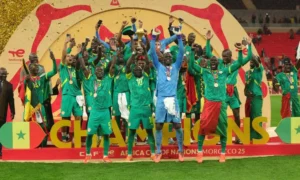
The Court of Arbitration for Sport (CAS) has restored Senegal’s status as Africa Cup of Nations champions, but the controversy surrounding the final against Morocco is far from settled.
Hours after the verdict was delivered in Lausanne on Tuesday, November 24, the Royal Moroccan Football Federation (FRMF) issued a statement rejecting aspects of the decision and announcing plans to pursue further legal action.
The announcement raises fresh questions about the next stage of a dispute that has stretched across several months, with Morocco refusing to accept the outcome of the latest ruling.
Morocco questions the integrity of the proceedings
In its statement, the FRMF said it had taken note of CAS’s decision but expressed dissatisfaction that its concerns about the integrity of the proceedings had not been considered.
At the centre of its complaint was an alleged contact between German CAS arbitrator Ulrich Haas and Senegalese Football Federation (FSF) president Abdoulaye Fall, reportedly 48 hours before the verdict was delivered.
The Moroccan federation argued that the alleged contact raised questions about the credibility of the decision-making process.
It also maintained that CAS had failed to adequately consider the legal consequences of players leaving the pitch without the referee’s authorisation, citing guidance from the International Football Association Board (IFAB) and FIFA.
The FRMF concluded its statement by announcing its intention to challenge the ruling.
“The Royal Moroccan Football Federation has decided to initiate all necessary legal procedures to challenge the CAS decision,” it said.
The allegation concerning Haas and Fall remains Morocco’s claim. It should not be treated as an established finding of wrongdoing.
CAS had already addressed Morocco’s complaint
Morocco’s latest statement followed an earlier attempt to raise the alleged contact with CAS before the verdict was announced.
At 3:47pm on Tuesday, the FRMF reportedly sent an official letter to the court expressing concern about the alleged incident involving Haas and Fall.
CAS subsequently explained that its commission responsible for recusal requests had considered the complaint but found insufficient evidence to delay the announcement.
“The commission responsible for these recusal requests considered that there was not enough evidence at this stage to postpone the notification of the sentence,” CAS stated.
The court’s response did not establish that the alleged contact was improper. Rather, it explained why the complaint had not provided sufficient grounds to postpone the verdict.
Why CAS restored Senegal’s title
The legal dispute originated from the chaotic conclusion to the AFCON 2025 final on January 18, when Senegal defeated Morocco 1–0 after extra time.
The controversy began in second-half stoppage time after referee Jean-Jacques Ndala Ngambo awarded Morocco a penalty following a VAR review for a foul on Brahim Díaz.
Senegal’s players left the pitch on the instruction of head coach Pape Thiaw, but Sadio Mané intervened and persuaded his teammates to return.
After play resumed, Díaz attempted a Panenka penalty that was saved by Édouard Mendy. Pape Gueye subsequently scored the decisive goal in extra time to secure Senegal’s victory.
CAF initially imposed disciplinary sanctions following the incidents. However, its Appeal Board later overturned the original outcome, awarded Morocco a 3–0 forfeit victory and declared them champions.
Senegal appealed that decision to CAS, arguing against the reversal of the result.
On Tuesday, the CAS panel unanimously upheld Senegal’s appeal, cancelled CAF’s Appeal Board decision and reinstated the earlier ruling of CAF’s Disciplinary Board.
The key issue was not whether Senegal’s walk-off was acceptable. It was whether the incident provided a legal basis for overturning a match that had subsequently resumed and reached its conclusion.
CAS concluded that the referee had authority to decide whether play should continue. By allowing the match to restart after both teams returned to the pitch, he had exercised that authority without committing an error of law.
The court also found that the relevant provisions of CAF’s regulations concerning a team abandoning a match did not apply because the referee had not permanently stopped the final.
Consequently, the original 1–0 result was restored, leaving Senegal as AFCON 2025 champions.
The disciplinary sanctions remain separate
Although Senegal won its appeal against the decision to overturn the final’s result, that does not mean the team and its federation escaped punishment for the incidents.
The disciplinary sanctions imposed by CAF’s Disciplinary Board remain in place.
Thiaw received a five-match suspension and a $100,000 fine, while Iliman Ndiaye and Ismaïla Sarr were each handed two-match suspensions.
The FSF was also fined $300,000 over the conduct of its supporters, another $300,000 for the behaviour of players and officials, and $15,000 for cautions received during the final.
Morocco also faced disciplinary sanctions for incidents involving its players, supporters and ball boys.