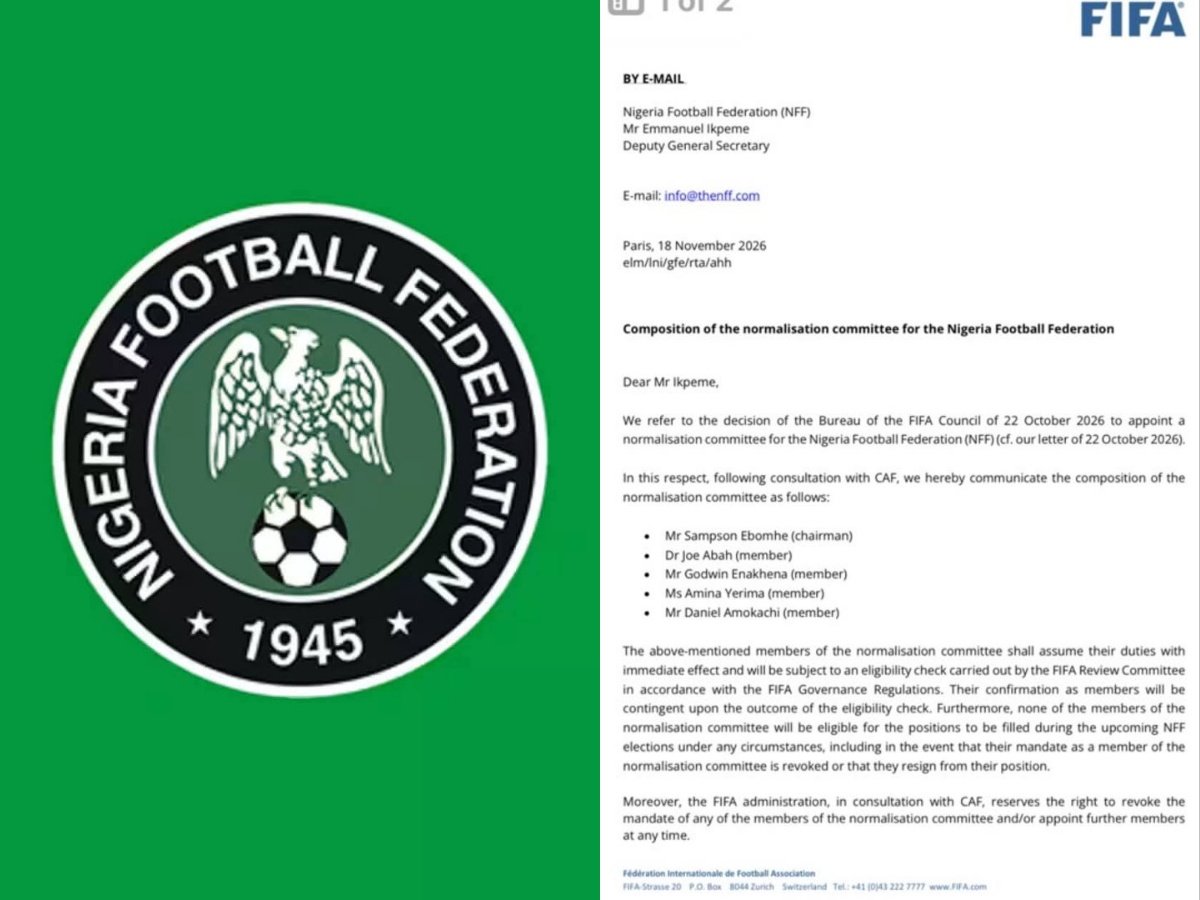
FIFA has taken another significant step towards resolving the leadership crisis in Nigerian football, formally communicating the composition of the normalisation committee appointed to oversee the Nigeria Football Federation (NFF).
The development provides clarity on the individuals selected to manage the transition after weeks of uncertainty surrounding the committee’s membership and the process leading to its constitution.
In a letter dated November 18, 2026, and addressed to NFF Deputy General Secretary Emmanuel Ikpeme, FIFA confirmed that five people had been selected following consultations with the Confederation of African Football (CAF).
However, their appointments come with conditions, including eligibility checks and restrictions that will prevent them from contesting positions in the next NFF elections.
Sampson Ebomhe named chairman as FIFA confirms five members
According to the letter from FIFA, Sampson Ebomhe will serve as chairman of the normalisation committee.
The other four members are:
-
Dr Joe Abah
-
Godwin Enakhena
-
Amina Yerima
-
Daniel Amokachi
FIFA stated that the members would assume their duties with immediate effect, although their confirmation remains subject to eligibility checks conducted by the FIFA Review Committee in accordance with the organisation’s Governance Regulations.
The letter, signed on behalf of FIFA, explained that the appointments would only be confirmed following the outcome of those checks.
The inclusion of former Super Eagles forward Daniel Amokachi also brings a familiar figure from Nigerian football into the body tasked with overseeing the federation’s transition.
FIFA bars committee members from contesting NFF elections
Beyond confirming the names, FIFA has made clear that membership of the normalisation committee will not provide an opportunity to seek elective positions in the next NFF administration.
The governing body stated that none of the five members would be eligible to contest any of the positions to be filled during the upcoming NFF elections.
Importantly, the restriction will remain in place even if a member’s mandate is revoked or they resign from the committee.
FIFA’s letter stated: “Furthermore, none of the members of the normalisation committee will be eligible for the positions to be filled during the upcoming NFF elections under any circumstances, including in the event that their mandate as a member of the normalisation committee is revoked or that they resign from their position.”
The provision establishes a clear separation between those appointed to manage the transition and individuals who may seek elected positions when the federation eventually returns to an elective administration.
It also means that leaving the committee before the end of its mandate will not remove the electoral restriction.
FIFA and CAF retain control over the committee’s composition
The November 18 communication also makes clear that the five-member list is not necessarily final.
FIFA stated that its administration, in consultation with CAF, reserves the right to revoke the mandate of any committee member or appoint additional members at any time.
The provision gives both governing bodies continued oversight of the committee’s composition throughout the normalisation process.
It also means that the five individuals named in the letter will operate under FIFA and CAF’s supervision rather than as an independent NFF leadership structure.
READ MORE: Ladan Bosso emerges as candidate for Abia Warriors job after Imama Amapakabo exit
The normalisation committee follows the leadership crisis that engulfed the NFF after the mass resignations of president Ibrahim Musa Gusau, General Secretary Mohammed Sanusi and other members of the federation’s executive leadership in August 2026.
Following consultations with Nigerian football stakeholders, a joint FIFA-CAF delegation became involved in efforts to establish a transition arrangement.
On October 22, 2026, the Bureau of the FIFA Council approved the appointment of a normalisation committee for the NFF, with its mandate expected to run until May 31, 2027, at the latest.
However, the identities of the committee members and the details of the composition remained outstanding, creating uncertainty around when the transition process would fully begin.
The latest letter now provides the names and outlines important conditions governing the committee’s work.
What happens next?
With the composition communicated, attention will turn to the eligibility checks and the committee’s assumption of responsibilities.
The FIFA Review Committee must complete its assessment before the five appointments can be formally confirmed under the conditions outlined in the letter.
The wider task of the normalisation process remains significant. The committee is expected to oversee the federation’s administration, implement necessary reforms and organise fresh elections within the period set by FIFA.