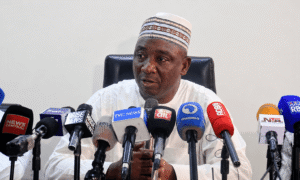
Nigeria Football Federation president Ibrahim Musa Gusau has defended the preparation of the Super Falcons for the 2026 Women’s Africa Cup of Nations, insisting that the federation made significant efforts to get the team ready for the tournament despite criticism of its approach.
Gusau’s defense comes after Nigeria’s WAFCON title defense ended in disappointing fashion with a 1-0 quarter-final defeat to Cameroon, leaving the Super Falcons outside the semi-finals and forcing them into a more difficult route towards qualification for the 2027 FIFA Women’s World Cup.
With questions being raised over whether Nigeria had done enough before the tournament, the NFF president pointed to the international friendlies arranged for the team as evidence of the federation’s efforts.
Gusau pointED to Cameroon friendlies
Gusau said the NFF deliberately sought strong African opposition for the Super Falcons as part of their preparations for the tournament.
He highlighted the meetings with Cameroon, including fixtures played both in Nigeria and in Yaoundé, arguing that the matches provided valuable preparation against a team Nigeria could realistically encounter at the WAFCON.
“We made Super Falcons have a friendly match with the Cameroonian national team in Nigeria and in Yaoundé,” Gusau said.
The preparation strategy proved particularly relevant because Cameroon eventually became Nigeria’s quarter-final opponent in Morocco.
The Indomitable Lionesses secured a 1-0 victory through Maéva Nyadjou’s first half goal, ending Nigeria’s hopes of defending the continental title.
For the NFF, however, the Cameroon fixtures were part of a broader attempt to expose the Falcons to competitive opposition before the tournament.
READMORE: Galatasaray reject Al-Hilal approach for Victor Osimhen
Gusau also cited Senegal among the teams Nigeria sought to play during the build-up to WAFCON.
According to the NFF president, the federation made efforts to organise another international friendly against the Teranga Lionesses as it attempted to give the Falcons further competitive preparation.
The challenge, he explained, was not simply identifying suitable opponents but making the fixtures financially and logistically possible.
International friendlies between African nations can involve significant travel and accommodation costs, while the availability of players based outside the continent can further complicate preparations.
Gusau said those factors meant that arranging additional matches was not always straightforward.
“Sometimes you have to take all the burden before you can make it,” he said.
He pointed to the Senegal fixture as an example of the financial commitment required to make an African international friendly happen.
NFF says preparation had its limitations
Gusau’s comments underline the federation’s argument that preparation for a major tournament cannot be assessed solely by counting the number of friendly matches played.
The NFF president said the availability of suitable opponents, the cost of bringing teams together and the timing of international windows all affected what could realistically be achieved before the tournament.
For Nigeria, the issue is particularly important because the Super Falcons have a large contingent of players based outside the country.
That means the federation must work within periods when clubs are required to release players, limiting the opportunities available for extended camps and additional fixtures.
The result is a preparation process that can be difficult to control, particularly when the objective is to assemble a squad early enough and expose it to meaningful opposition before a major tournament.
READMORE: NPFL: Imama Amapakabo emerges as leading candidate for Shooting Stars job
The debate over Nigeria’s preparation intensified after the quarter-final defeat. The Super Falcons had entered the tournament as defending champions and one of the favourites for the title, but their campaign was ultimately ended by a narrow defeat despite creating opportunities to get back into the contest.
The result also meant Nigeria missed out on the opportunity to secure their World Cup qualification place through the tournament’s direct route.
That has increased scrutiny around several aspects of the team’s campaign, including preparation, tactical execution and the federation’s decision making before the competition.
Gusau, however, maintains that the NFF made a genuine effort within the circumstances it faced.
CLICK HERE TO JOIN ATHLETIC NG WHATSAPP CHANNEL NOW!
Nigeria must now shift its attention towards South Africa, with the two sides meeting in a crucial World Cup playoff in Casablanca.
The winner will advance to the inter-confederation playoffs for the 2027 FIFA Women’s World Cup, while the loser will see its qualification hopes come to an end.