
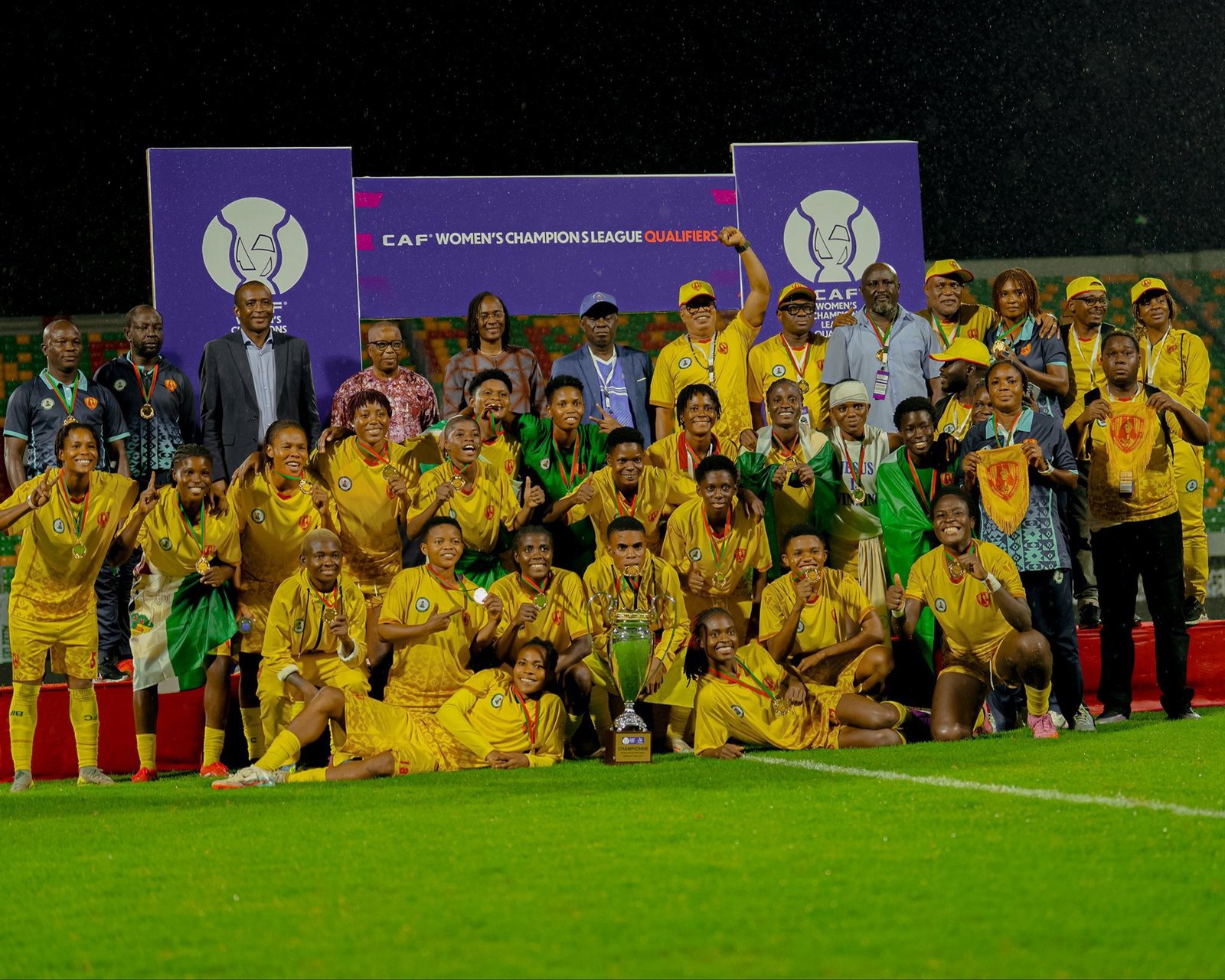
Edo Queens must return to the pitch to settle a final they thought they had won after the Confederation of African Football (CAF) rejected the Nigeria Football Federation’s (NFF) appeal against the annulment of their penalty shootout victory over Ghanaian champions Ampem Darkoa Ladies in the WAFU Zone B qualifying final for the 2026 CAF Women’s Champions League.
The Nigerian champions had beaten Ampem Darkoa 4–1 on penalties after the final ended 2–2 at the August 4 Stadium in Ouagadougou, Burkina Faso, on 5 September 2026.
That result appeared to have secured the title and a place in the continental tournament, but a procedural error by the match officials turned the celebrations into a dispute that has now reached the CAF Appeal Board.
The latest ruling, dated 16 October, upheld CAF’s original decision to annul the shootout and ordered the match to resume from the beginning of extra time, with the score remaining 2–2.
The teams are scheduled to continue the contest on Saturday, 24 October, in Burkina Faso, according to reports published on Monday.
The winner will claim the WAFU Zone B qualification place at the 2026 CAF Women’s Champions League final tournament, leaving both clubs with one more opportunity to settle a contest whose outcome has remained unresolved for weeks.
How the controversy began
The original final was closely contested, with both teams scoring twice during regulation time. However, instead of proceeding to two 15-minute periods of extra time, as required by the competition regulations, the match officials sent the teams directly into a penalty shootout.
Edo Queens won the shootout 4–1 and were declared champions, but Ampem Darkoa challenged the procedure through the Ghana Football Association, arguing that the failure to play extra time breached the regulations governing the competition.
CAF’s Organising Committee for Women’s Football upheld the protest in a decision dated 26 September. It ruled that Articles 13.1 and 72.4 of the CAF Women’s Champions League regulations required extra time to be played before penalties could determine the winner of a drawn final.
The committee attributed the error to an administrative instruction given to the match officials, rather than wrongdoing by either team.
READ MORE: Doma United hit with ₦5.25m fine and multiple stadium ban after Kun Khalifat incident
According to the ruling, officials had initially been informed that extra time would be required if the match ended level, but were subsequently instructed to proceed directly to penalties.
CAF acknowledged that the referee acted in good faith on the instruction, while concluding that the procedure used to determine the winner was contrary to the competition rules.
Ampem Darkoa had sought a full replay or, alternatively, a continuation from the end of regulation time. CAF rejected a complete replay because the initial 90 minutes had been validly played and found no evidence that the procedural error had affected that portion of the match.
Instead, it annulled the penalty shootout and ordered the final to resume from the start of extra time, with the score at 2–2.
Why the NFF challenged the decision
The ruling did not end the dispute. The NFF appealed on behalf of Edo Queens, arguing that the Nigerian side should not lose the sporting reward of a victory achieved after following the match officials’ instructions.
In its appeal, filed on 29 September, the federation maintained that the players neither requested the omission of extra time nor caused the officials to proceed directly to penalties.
Edo Queens had simply complied with the referee’s directions, the NFF argued, and should not be held responsible for an administrative error beyond the club’s control.
The federation also questioned the regulatory basis for cancelling a completed shootout when neither participating team had been found responsible for the irregularity.
It asked the Appeals Committee to restore Edo Queens’ 4–1 penalty victory and the qualification place that came with it.
The argument centred on sporting fairness: whether a team that followed the officials’ instructions should lose a result because the prescribed procedure had not been followed.
However, the CAF Appeal Board did not accept the NFF’s challenge. Its 16 October decision upheld the original ruling, leaving the annulment in place and requiring the final to be decided on the pitch through the missing extra time period. It also directed that different match officials be appointed for the continuation.
What happens when the teams return?
The resumption will not begin with a fresh kick off or a replay of the full match. Instead, the teams will restart from the beginning of extra time, with the original 2–2 scoreline intact.
They will play two 15-minute periods. If neither side establishes a lead after the additional 30 minutes, a new penalty shootout will determine the winner.
The arrangements are also intended to preserve, as far as practically and legally possible, the sporting conditions that existed at the end of the original 90 minutes.
This includes the players who were on the pitch, the availability of eligible substitutes, disciplinary records and the substitutions already used by each team.
Those provisions mean the continuation will be more than an ordinary extra-time contest. Both teams must return to resolve the remaining portion of the final under the conditions set by CAF, rather than approach it as a new match.
The decision also leaves the WAFU Zone B qualification place unassigned until the contest is completed. Edo Queens cannot rely on their original shootout victory, while Ampem Darkoa must still win the remaining contest to claim the ticket.
What is at stake for Edo Queens and Ampem Darkoa?
The challenge for Edo Queens is to convert their original performance into a result that stands under the competition regulations. The Benin City club had celebrated a victory that appeared to settle the contest, only for the result to be removed from the record because extra time had not been played.
Meanwhile, Ampem Darkoa have secured the right to continue a final in which they were level after 90 minutes. The Ghanaian champions’ protest succeeded on procedural grounds, but they still have to complete the sporting task of winning the contest.
CLICK HERE TO JOIN ATHLETIC NG WHATSAPP CHANNEL NOW!
The stakes extend beyond the regional title. The winner will represent WAFU Zone B at the 2026 CAF Women’s Champions League final tournament, scheduled to take place in Egypt from 1 to 15 November.
The dispute has therefore delayed the confirmation of one of the competition’s representatives and placed renewed importance on the remaining 30 minutes, with a possible penalty shootout to follow.






































Pingback: FIFA punishes Egypt coach Hossam Hassan and Ziko over Argentina World Cup clash - The Athletic NG