
Andoni Iraola has questioned the message Premier League refereeing is sending to attacking players after suggesting that Liverpool may have to encourage their forwards to go to ground to win penalties.
The Liverpool manager was reacting to his side’s 1–0 defeat by Arsenal at Anfield on Sunday, where Alexander Isak remained on his feet despite having his shirt pulled inside the penalty area.
The incident has since become one of the weekend’s most debated officiating decisions, particularly after referee Andy Madley and VAR official Stuart Attwell declined to award a spot kick.
But the debate has taken on another dimension following a separate controversy at Stamford Bridge, where Chelsea winger Estêvão had a late goal ruled out after a marginal VAR offside decision against Manchester United.
The two incidents involved different laws of the game, but their proximity has intensified questions about the way marginal decisions are being judged and the influence of VAR on Premier League football.
Isak’s decision to stay on his feet frustrates Iraola
Liverpool were trailing Arsenal after Kai Havertz’s goal when the controversy unfolded in the first half.
Bradley Barcola delivered a cross into the penalty area, with Isak attempting to get in front of Jurrien Timber to reach the ball. The Arsenal defender appeared to pull the Swedish striker’s shirt, preventing him from making the connection.
Isak remained upright and did not make an obvious appeal, while Madley allowed play to continue.
VAR subsequently reviewed the incident but concluded that the contact was insufficient to overturn the referee’s original decision.
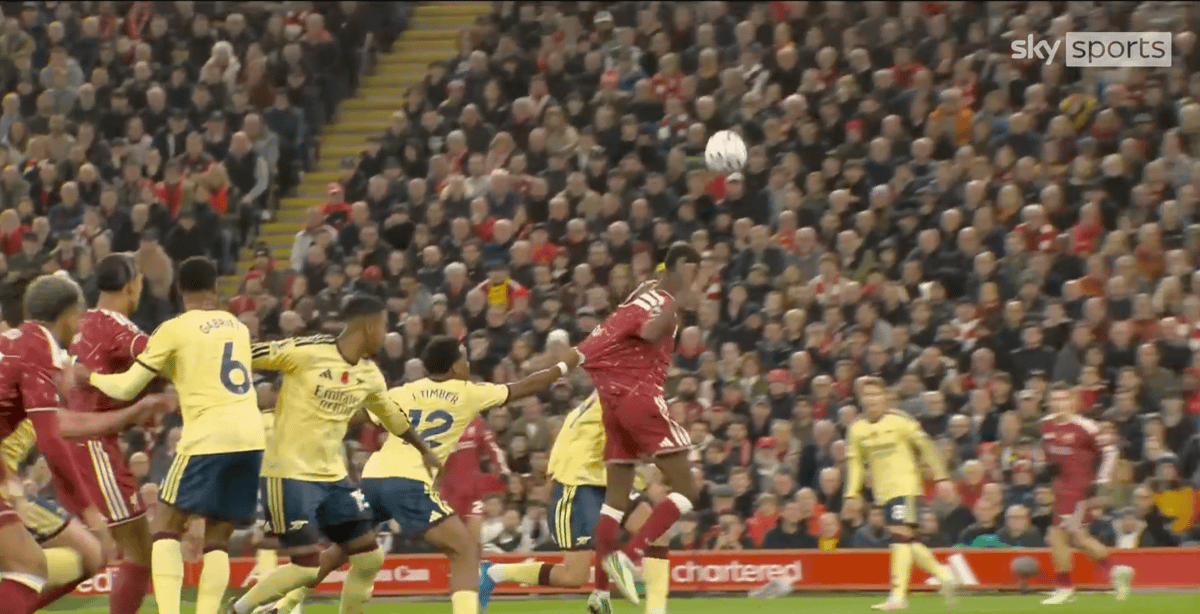
Jurrien Timber appears to pull Alexander Isak’s shirt as the Liverpool forward attempts to reach the ball inside Arsenal’s penalty area, sparking a major penalty controversy after referee Andy Madley waved play on. Photo source: Sky Sports
Iraola was unconvinced, arguing that the shirt pull had directly prevented his striker from getting to a potentially dangerous delivery.
“There is a clear grab of the shirt,” the Liverpool manager told Match of the Day.
“Alex [Isak] was just in front of him, he was going to head in front of the goal but couldn’t because he grabbed the shirt.
“If he goes to the floor, they call the penalty 100%. It should be like this but it is what it is. Next time, the managers should tell Alex to go to the floor, otherwise they won’t call it.”
His frustration became even more apparent when he was asked what players should do in similar situations.
“The answer is you have to dive, if you don’t dive they won’t call it,” he added.
Asked whether he would actually give Isak that instruction, Iraola was unequivocal.
“Yes, definitely.”
Chelsea’s Estêvão provides another talking point
While Liverpool’s complaint centred on a shirt pull inside the penalty area, another VAR intervention at Stamford Bridge had already generated debate over the margins involved in offside decisions.
Chelsea defeated Manchester United 2–0 on Saturday, but the scoreline could have been more emphatic had Estêvão’s second half finish been allowed to stand.
With Chelsea leading through Morgan Rogers and Cole Palmer, the Brazilian winger appeared to make it 3–0 after Palmer played him through on goal.
Estêvão advanced and fired a powerful finish into the roof of the net, celebrating with his teammates as Stamford Bridge anticipated another goal.
However, a delayed VAR review overturned the on-field decision, with the goal disallowed for offside in the 72nd minute.
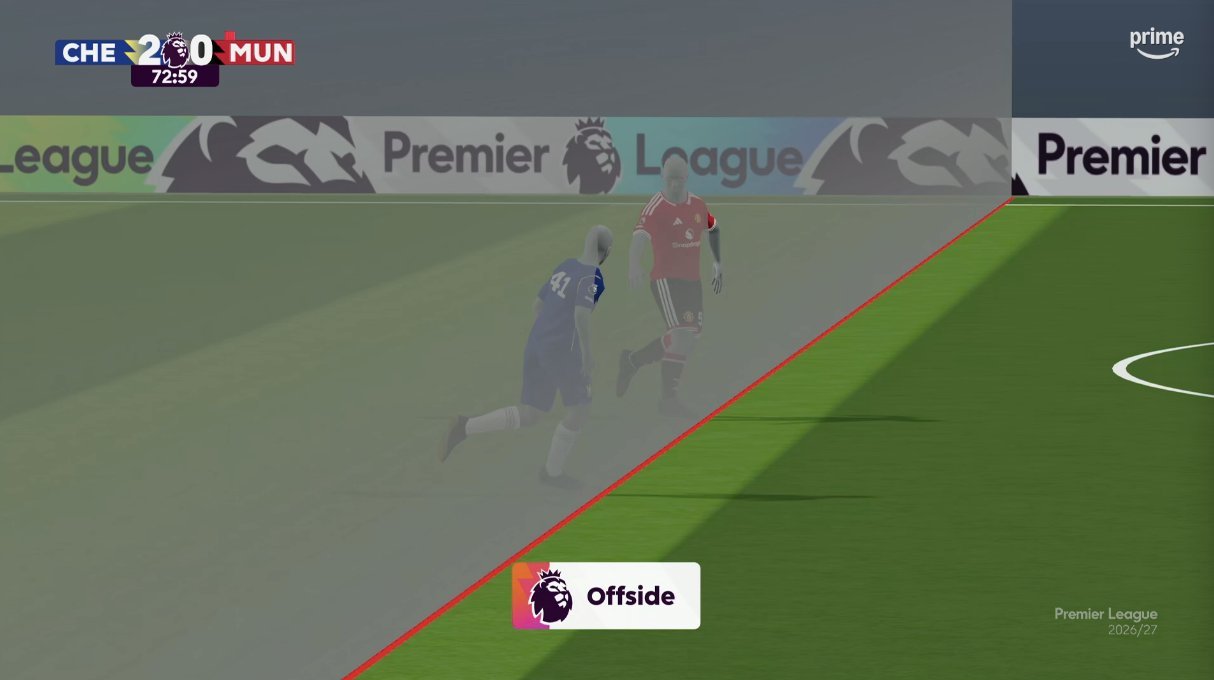
2. A tight offside call denied Estêvão a goal at Stamford Bridge, with VAR overturning the decision after Cole Palmer had released the Brazilian behind Manchester United’s defence. Photo Source: Premier League
The decision was particularly frustrating for the Chelsea youngster because it was described as marginal. Palmer later suggested the margin was extremely narrow when discussing his teammate’s performance.
“He was unlucky with the offside; I think it was literally a centimetre,” the Chelsea midfielder said.
The Premier League Match Centre subsequently confirmed that VAR had determined Estêvão was in an offside position and recommended that the goal be disallowed.
It was not even the first time Estêvão had been denied a goal in the contest. An earlier effort in the opening half had also been ruled out for offside.
Two incidents, one growing debate about consistency
The comparison between the two matches needs some distinction.
Offside decisions are determined by the position of an attacking player when the ball is played, while a penalty appeal requires officials to assess whether a defender has committed an offence inside the area.
The fact that Estêvão was denied by a marginal offside call does not, by itself, establish that the decision against Isak was wrong.
However, both incidents have placed the spotlight on the level of scrutiny applied to decisive moments and the expectations placed on players when contact occurs.
In Liverpool’s case, Iraola believes Isak’s decision to remain standing should not have worked against him when the shirt pull had impeded his attempt to reach the ball.
The Spaniard also acknowledged that Liverpool’s separate appeal involving Cody Gakpo was different, accepting that the contact from Christos Tzolis did not warrant a penalty.
His concern was specifically about the Isak incident and what he sees as an incentive for players to exaggerate contact to attract the referee’s attention.
That is the contradiction at the heart of his argument: referees regularly criticise simulation, yet players and coaches may feel that staying upright after being fouled reduces their chances of receiving a decision.
Van Dijk joins Liverpool’s criticism
Liverpool captain Virgil van Dijk also questioned why the incident involving Isak was not punished.
“I’ve seen it back and I’ve seen it given as well on other occasions. Today it wasn’t meant to be,” he said.
The Dutch defender also questioned the need for Isak to make a more dramatic appeal when the incident could be reviewed through the available camera angles.
“We have 50 cameras. Even more. Why does he [Isak] have to complain when there are so many cameras? Everyone has seen it. In the end it wasn’t given and we lose the game unfortunately, so well done to Arsenal.”
Former Premier League assistant referee Darren Cann, discussing the incident with BBC Sport, said Timber had taken a significant risk by pulling the Liverpool forward’s shirt.
“Timber takes a huge risk by grabbing the shirt. It could easily have been given on another day,” Cann said.
“It’s right on the limit. It has to be sustained holding – some will say it was sustained, some will say it wasn’t. But it’s interesting that Isak didn’t even appeal.”
The debate therefore extends beyond whether Liverpool should have received a penalty. It raises a broader question about how officials interpret contact, how much players are expected to demonstrate that they have been impeded and whether the current approach is unintentionally encouraging simulation.
READ MORE: NPFL Matchday 11 roundup: Rangers enter history, Bendel Insurance and Enyimba while Inter Lagos crisis deepens
Iraola’s proposed response is unlikely to be welcomed by those who want to reduce diving and gamesmanship in football.
Yet his frustration reflects a concern that has resurfaced repeatedly in the Premier League: players who attempt to stay on their feet may believe they are being disadvantaged when officials assess penalty appeals.
Estêvão’s marginal offside decision at Stamford Bridge provides a reminder of how fine the margins can be under VAR, even though it was a different type of decision and the Premier League has confirmed the offside ruling.
The consequence for Liverpool was a defeat that left them frustrated after failing to find an equaliser. For Chelsea, the disallowed goal did not prevent a 2–0 victory.
But the weekend’s incidents have added to the scrutiny surrounding Premier League officiating.
CLICK HERE TO JOIN ATHLETIC NG WHATSAPP CHANNEL NOW!
If players begin to believe that going to ground is the surest way to convince referees that they have been fouled, the consequences could extend beyond one controversial penalty appeal.
And that is perhaps the most uncomfortable question raised by Iraola’s comments: should football be encouraging players to stay honest, or teaching them how to make an offence look convincing enough to be punished?







































Pingback: FG’s message after Samson Adamu’s CAF appointment points to something bigger - The Athletic NG