
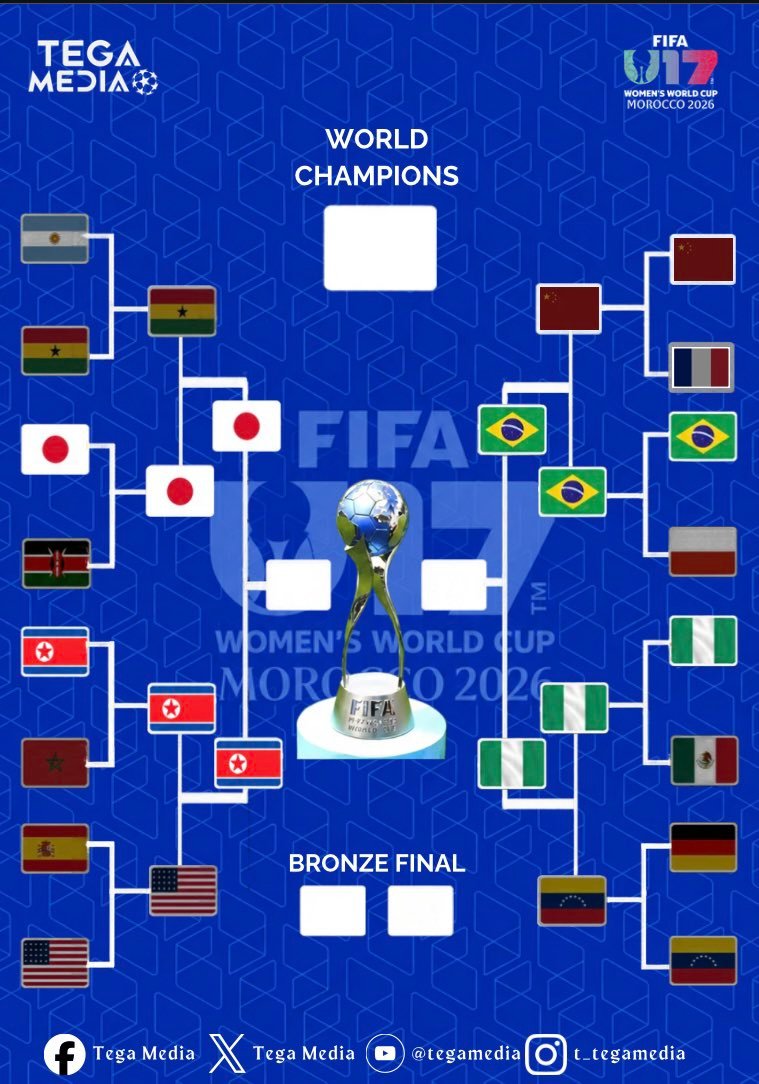
The Mohammed VI Football Complex, Pitch 3, in Rabat, Morocco, will provide the setting for a defining night in the history of women’s youth football when Brazil and Nigeria meet in the FIFA U-17 Women’s World Cup semi finals on Wednesday, 4 November 2026. Kickoff is scheduled for 6:00 pm local time (7:00 pm in Nigeria), with both nations chasing a place in a final neither has ever reached.
The opportunity represents another chance for Brazil to move beyond the disappointment of last year’s semi final defeat. For Nigeria, it is an opportunity to improve on the bronze medal finish achieved at India 2022 and establish a new landmark for the Flamingos.
The two sides have arrived in the last four through contrasting routes. Brazil remain unbeaten after five matches, scoring 17 goals and demonstrating considerable attacking depth. Nigeria, meanwhile, have recovered from an opening defeat to Poland to win four consecutive matches, including a statement victory over defending champions DPR Korea.
Those records set up an intriguing contest. Brazil have been the more prolific side in front of goal, but Nigeria have conceded fewer goals and built their campaign around defensive organisation, collective discipline and timely attacking contributions.
The winner will advance to the final on 7 November, while the losing side will contest the third place match. With a first ever final within reach for both countries, the stakes extend beyond another knockout victory.
Why this match matters
This semi-final is an opportunity to remove a significant barrier in the history of both nations at the FIFA U-17 Women’s World Cup.
Brazil reached the semi finals for the first time in 2025, when the tournament was also hosted in Morocco. Their campaign ended in disappointment after a 2-0 defeat to eventual champions DPR Korea, followed by another loss in the third-place match. Finishing fourth was a considerable achievement, but it also left the Seleção with unfinished business.
Rilany’s team have returned to the same stage a year later, giving them an opportunity to improve on that performance and compete for the title. Their unbeaten run suggests they have the attacking resources to challenge for a place in the final, although their journey has also exposed defensive vulnerabilities that Nigeria will hope to exploit.
Nigeria’s history at this level is different but carries a similar sense of unfinished business. The Flamingos reached the last four at India 2022, where they lost to Colombia before recovering to defeat Germany in the third-place match and claim the bronze medal. That remains Nigeria’s best finish in the competition.
Four years later, Akeem Busari’s side have another opportunity to move beyond the semi final barrier. Reaching the final would give Nigeria their first appearance in the championship match and provide the team with a chance to compete for a world title at this age level.
There is also a wider significance for Nigerian women’s football. The Flamingos have already demonstrated their ability to compete against established youth teams, and a place in the final would add another major achievement to the country’s record in international women’s football.
For both teams, Wednesday’s match is about more than reaching a final. It is about turning previous semi-final experiences into a breakthrough.
Current form
Brazil enter the semi-final with an unbeaten record of three wins and two draws from five matches. Their 17 goals underline the scale of their attacking threat, although the nine goals conceded indicate that opponents have found ways to trouble their defence.
Their campaign began with a 6-2 victory over Canada on 18 October. Canada took an early lead through Reed Tingley, but Helena equalised in first half stoppage time before Brazil produced five goals after the break. Nicolly Manuel, Marcela Bontorim, Greise Kelly, who scored twice, and Pepe completed the emphatic response.
The Seleção were then held to a 3-3 draw by Ghana in a match that exposed some of their defensive difficulties. Nicolly Manuel, Kaillany Ranifah and Indy scored for Brazil, but Ghana responded through Rafia Osman, Gloria Ameaa and Priscilla Mensah.
Brazil recovered against Norway, winning 3-0 through goals from Carol Melo, Sofia Gamonal and Helena to finish their group campaign on a positive note.
Their Round of 16 meeting with Poland was considerably more complicated. Brazil scored through Greise Kelly, Marcela Bontorim and Pepe, but Poland fought back to force a 3-3 draw. The Seleção eventually advanced after an 8-7 penalty shoot-out victory, with goalkeeper Nathy saving two attempts and Sofia Gamonal converting the decisive kick.
The quarter final against China PR demanded another recovery. Wu Yichen put China ahead in the 42nd minute, but Helena equalised just 42 seconds after the restart before scoring again in the 87th minute to secure a 2-1 victory.
Brazil’s campaign has therefore been defined by attacking production and an ability to respond when placed under pressure. Their capacity to recover from difficult situations is a strength, but conceding nine goals in five matches is a statistic Nigeria will not overlook.
The Flamingos have taken a different route to the last four.
Nigeria opened their Group B campaign with a 2-1 defeat to Poland on 17 October. Wiktoria Skrzypczak converted a penalty in the 33rd minute before Natalia Skrok doubled Poland’s advantage. Oluebube Umejiaku pulled one back in the 79th minute, but Nigeria could not find an equaliser.
That defeat threatened to complicate their route through the group, but Busari’s players responded with a 2-0 victory over Puerto Rico. Oluwakemi Adegbuyi opened the scoring in the 25th minute before Precious Oscar added a second in stoppage time.
The result against defending champions DPR Korea was an even stronger statement. Adegbuyi scored in the 15th minute, Umejiaku doubled Nigeria’s advantage in the 38th minute and Kanyinsola Yusuf made it 3-0 in the 56th minute. Yu Jong-hyang converted a penalty in the 82nd minute, but Nigeria held on for a 3-1 victory.
The win ended DPR Korea’s 18-match unbeaten run in regulation time at the tournament, dating back to their 4-1 defeat to Germany on 14 November 2018.
Nigeria carried that momentum into the knockout rounds, beating Mexico 2-1 in the Round of 16. Umejiaku scored in the 40th minute and Mary Dunstan added a second in the 71st, before Emily Delgado pulled one back late for Mexico.
The quarter-final against Venezuela was a different kind of examination. Nigeria created opportunities but struggled to break down a determined defence and goalkeeper Valeria Rebanales.
With the contest approaching a penalty shoot-out, Umejiaku was fouled inside the box and Azeezat Oduntan converted from the spot in the 89th minute to secure a 1-0 victory.
Four successive victories have followed the opening defeat to Poland. The Flamingos have shown they can win through attacking quality, withstand pressure and remain patient when opponents make space difficult to find. That variety will be important against Brazil.
Historical context
Brazil and Nigeria have met twice at the FIFA U-17 Women’s World Cup, with the South Americans recording one victory and one draw. Neither previous meeting took place in the semi-finals, making Wednesday’s encounter their first clash at this stage of the competition.
Their first meeting came on 5 November 2008 and produced a 2-2 draw. Ketlen gave Brazil the lead in the 35th minute before Orji equalised for Nigeria eight minutes later. Rafaelle restored Brazil’s advantage in the 71st minute, but Okoronkwo responded four minutes later to secure a share of the points.
The second encounter took place on 1 October 2016, when Brazil claimed a 1-0 victory through Micaelly’s 42nd-minute goal.
Brazil therefore hold the historical advantage, having avoided defeat in both previous meetings. However, those results offer only limited guidance for Wednesday’s contest. The players, coaches and circumstances have changed, while both teams have developed different identities across the intervening years.
The more relevant historical comparison may be what each nation has achieved in the competition’s semi-finals. Brazil are seeking to improve on their fourth-place finish in 2025, while Nigeria are trying to surpass the bronze medal won in 2022.
Neither country has played in the final. That shared ambition gives this meeting an additional layer of significance.
Key battle: Greise Kelly against Nigeria’s defensive organisation
Greise Kelly is likely to be one of the central figures in Brazil’s attempt to reach the final.
The forward has scored three goals and provided five assists in the tournament, giving her eight direct goal contributions. Her five assists are the highest recorded by any player at Morocco 2026, while FIFA’s statistical analysis has credited her with involvement in 47.06 per cent of Brazil’s goals.
Those figures reveal why Nigeria cannot afford to focus exclusively on the players finishing Brazil’s attacking moves. Greise is capable of creating the decisive moment herself, whether through dribbling, passing or delivery into dangerous areas.
Her influence was evident in the quarter-final against China PR, where she assisted Helena’s equaliser and contributed to the move that produced the winning goal.
Nigeria will need a collective plan to limit her effectiveness. Allowing Greise time to turn, carry the ball towards the penalty area or pick out runners could place the Flamingos’ back line under sustained pressure.
The responsibility will not belong to one defender. Nigeria’s midfield must help close passing lanes, while the defensive line will need to maintain its shape and avoid being pulled out of position.
The challenge is complicated by Brazil’s attacking depth. Helena, Marcela Bontorim, Nicolly Manuel and Pepe all offer different threats, meaning Nigeria cannot simply concentrate their defensive attention on Greise.
For the Flamingos, limiting the Brazilian creator’s influence while remaining alert to the movement around her could be one of the defining tasks of the match.
Tactical angle: Brazil’s technical quality against Nigeria’s intensity
The tactical contest could develop around Brazil’s ability to establish attacking combinations and Nigeria’s capacity to disrupt them without losing their defensive structure.
Brazil have demonstrated that they can create goals through several routes. Greise Kelly provides creativity and assists, Helena offers movement and finishing, while Marcela Bontorim, Nicolly Manuel and Pepe give the team additional options in the final third.
Their 17 goals in five matches reflect a side comfortable committing players forward and attacking with numbers. However, the nine goals conceded also suggest that their attacking ambition can leave spaces for opponents to exploit.
Nigeria’s defensive organisation could make those spaces important. The Flamingos have conceded four goals in five matches, a record that compares favourably with Brazil’s, and have shown an ability to remain compact when opponents dominate possession or attack patiently.
The midfield battle will be crucial. Favour Nkwocha, Mary Dunstan and Tosin Rafiu could have important roles in disrupting Brazil’s combinations, recovering possession and helping Nigeria move quickly into attack.
If the Flamingos press too aggressively without maintaining cover behind the ball, Brazil’s technical players could exploit the spaces left between the lines. But if Nigeria allow the Seleção to settle into a rhythm, Greise and her attacking teammates may have more opportunities to dictate the game.
Nigeria must therefore find the right balance between physical intensity and positional discipline. Winning the ball is only part of the task; what follows possession will matter just as much.
The Flamingos also need to make their attacking moments count. Their victories over DPR Korea and Mexico demonstrated that they can create decisive opportunities, while the late winner against Venezuela showed the value of remaining patient until the final stages.
Brazil’s defensive record suggests there may be openings, but Nigeria will need composure and precision to take advantage.
Predicted lineups and team news
The following projected starting teams are based on recent selections, player roles and performances during the tournament. They are not confirmed line-ups.
Brazil predicted XI
Formation: 4-3-3
Nathy; Andreyna, Yasmin Queiroz, Isa Rech, Sarah Coelho; Carol Melo, Sofia Gamonal, Greise Kelly; Pepe, Helena, Marcela Bontorim.
Coach: Rilany
Brazil are expected to draw heavily on the side that started the quarter-final against China PR. Helena’s two goals in that match strengthened her case to lead the attack, while Greise Kelly’s creative influence makes her a key component of the expected forward line.
Marcela Bontorim and Pepe offer additional attacking options, while Sofia Gamonal is expected to feature after converting the decisive penalty in the shoot-out against Poland. Nathy is also projected to retain the goalkeeping position following her important saves in that encounter.
The predicted 4-3-3 would give Brazil the width and attacking numbers they have used effectively throughout the competition.
Nigeria predicted XI
Formation: 4-1-2-3
Jane Ijirigho; Azeezat Oduntan, Ohunene Sunday, Esther Stephen, Kanyinsola Yusuf; Mary Dunstan; Favour Nkwocha, Tosin Rafiu; Queen Joseph, Oluwakemi Adegbuyi, Oluebube Umejiaku.
Coach: Akeem Busari
Busari retained the same starting XI for the quarter-final against Venezuela that had begun the Round of 16 meeting with Mexico. That continuity makes another unchanged selection a reasonable possibility for the semi-final.
Jane Ijirigho is expected to remain in goal, with the defensive unit tasked with containing Brazil’s movement and attacking combinations. Mary Dunstan could provide the holding presence in midfield, allowing Nkwocha and Rafiu to contribute to both the defensive work and forward transitions.
Umejiaku and Adegbuyi are expected to carry much of the attacking responsibility, while Queen Joseph could provide another option in the forward line.
Busari may still adjust the team’s approach depending on how Brazil set up, particularly if he wants additional protection in central areas.
The Numbers that matter
The statistics reveal two teams with different strengths, but also provide clues about where Wednesday’s semi final could be decided.
Brazil
-
Unbeaten in five matches at Morocco 2026, with three wins and two draws.
-
Scored 17 goals and conceded nine.
-
Scored six goals against Canada in their opening match.
-
Drew 3-3 with Ghana and 3-3 with Poland.
-
Advanced past Poland after an 8-7 penalty shoot-out victory.
-
Beat China PR 2-1 in the quarter-final.
-
Greise Kelly has three goals and five assists, giving her eight direct goal contributions.
-
Greise’s five assists are the highest recorded by any player at the tournament.
-
Helena scored both goals in the quarter final against China PR.
Nigeria
-
Won four consecutive matches after losing their opening game against Poland.
-
Scored nine goals and conceded four across five matches.
-
Defeated defending champions DPR Korea 3-1 in the group stage.
-
Ended DPR Korea’s 18-match unbeaten run in regulation time at the competition.
-
Beat Mexico 2-1 in the Round of 16.
-
Defeated Venezuela 1-0 in the quarter-final through an 89th-minute penalty.
-
Jane Ijirigho has made 16 saves in the tournament.
-
Oluebube Umejiaku has scored three goals.
-
Oluwakemi Adegbuyi has scored twice.
The historical record
-
Brazil and Nigeria have met twice at the FIFA U-17 Women’s World Cup.
-
Brazil have recorded one win and one draw in those encounters.
-
Their first meeting in 2008 ended 2-2.
-
Brazil won the 2016 meeting 1-0.
-
Neither nation has previously reached the tournament final.
The most striking comparison is the gap between Brazil’s attacking output and Nigeria’s defensive record. The Seleção have scored eight more goals, but have also conceded five more than the Flamingos.
Those figures do not guarantee how the semi-final will unfold, but they illustrate the contrasting strengths that could shape it.
READ MORE: What Ademola Lookman must change to reclaim his place in Simeone’s Atletico team
Brazil coach Rilany has already identified Nigeria’s physical strength and endurance as important challenges ahead of the semi final.
Speaking to FIFA after her team’s quarter-final victory over China PR, she said:
“Nigeria are a very physical team. By the 90th minute, they’ll probably still be running as if it were the fifth.”
Rilany also indicated that Brazil would need to be strategic in finding ways to hurt the Flamingos. Her comments suggest that the Seleção are conscious of the physical demands Nigeria can impose, particularly as the match progresses.
The Brazilian coach has also highlighted her team’s mentality as one of its greatest strengths, pointing to the resilience that has helped them recover from difficult situations during the tournament.
Nigeria coach Akeem Busari, meanwhile, has spoken about the effort required to reach the semi finals and the team’s determination to continue their journey.
Following the victory over Venezuela, he told FIFA:
“We gave everything on the pitch tonight. We wanted to keep the ball and play our game, but we made some mistakes. We kept pushing until the end.”
Busari described reaching the semi-finals as a dream come true and said the team wanted to make the country proud in their next match.
The comments offer an insight into the contrasting approaches expected in Rabat. Brazil recognise the physical challenge Nigeria will bring, while the Flamingos’ coach has emphasised the importance of persistence and commitment.
Neither side appears short of motivation. The question is which team can impose its strengths for longer.
CLICK HERE TO JOIN ATHLETIC NG WHATSAPP CHANNEL NOW!
Brazil have the attacking numbers, the unbeaten record and the experience of reaching last year’s semi finals. Their 17 goals demonstrate the variety of threats available to Rilany, while Greise Kelly’s creative influence and Helena’s finishing give the Seleção a dangerous combination in the final third.
But Nigeria have reasons to believe they can disrupt that momentum.
The Flamingos have conceded only four goals in five matches, recovered impressively from their opening defeat and eliminated the defending champions. Their victory over DPR Korea demonstrated their ability to compete against elite opposition, while the late breakthrough against Venezuela showed that they can remain composed when a match becomes difficult.
The most important challenge for Busari’s team will be maintaining defensive concentration without becoming too passive. Brazil’s attacking quality demands respect, but Nigeria cannot allow the threat of conceding to prevent them from making their own attacking intentions count.
Greise Kelly’s influence, the midfield contest and the Flamingos’ ability to convert opportunities could ultimately determine which nation takes the final step.
A place in the final would be a historic achievement for either side. Nigeria have already shown that they can overcome difficult opponents in Morocco; now they must produce another disciplined and confident performance against an unbeaten Brazil team.
TheAthleticNG Prediction: Brazil 1-0 Nigeria
This is likely to be a closely contested semi final, with Brazil’s attacking depth giving them a slight advantage. Their ability to create chances through Greise Kelly, Helena and the supporting forwards could eventually test Nigeria’s defensive organisation over the course of the match.
However, the Flamingos have enough attacking quality to trouble Brazil’s defence, which has conceded nine goals in five games. Umejiaku and Adegbuyi could find opportunities if Nigeria transition quickly and make effective use of the spaces available.
Nigeria’s resilience should keep the contest competitive, but Brazil’s greater attacking output may prove decisive.




































Pingback: CAF Awards 2026: Why Nnadozie missed out but Super Falcons earned nomination - The Athletic NG