
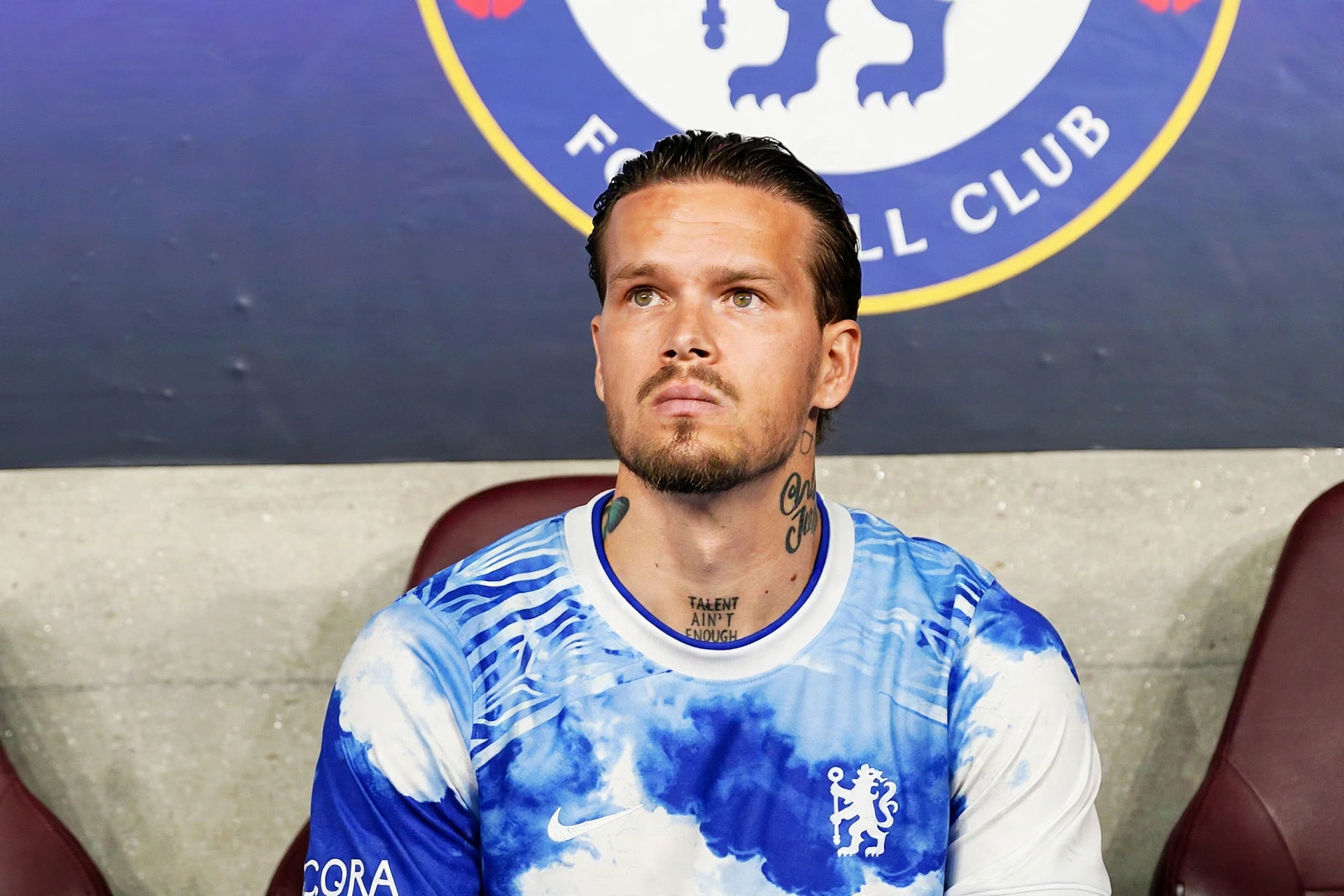
Mykhailo Mudryk has opened up about the doping case that kept him away from competitive football for almost 20 months, describing the emotional impact of his suspension and the difficult period that followed.
The Chelsea winger, currently on loan at Tottenham, has also questioned the support he received from the Ukrainian Football Association (UAF), including its president, Andriy Shevchenko, during the investigation.
In an interview with Ukrainian journalist Dmytro Gordon on the YouTube channel Guest of Gordon, published on Wednesday, November 18, Mudryk discussed the circumstances surrounding his positive test for meldonium and explained why he believes the substance entered his body while he was with the national team.
His account has brought fresh attention to a case that began in late 2024 and eventually threatened to keep him out of football until 2028.
How Mudryk’s doping case began
The controversy emerged after an out-of-competition doping test conducted on October 22, 2024, detected a low concentration of meldonium, a prohibited substance, in Mudryk’s sample.
The Football Association (FA) notified the player of the finding on December 4, 2024, and imposed a provisional suspension. Chelsea subsequently confirmed that the winger had been contacted over an adverse finding in a routine urine test.
At the time, Mudryk insisted that he had never knowingly taken a banned substance.
“This has come as a complete shock as I have never knowingly used any banned substances or broken any rules, and am working closely with my team to investigate how this could have happened,” he said in a statement released after the news emerged.
The FA formally charged him with anti-doping rule violations in May 2025. Following a hearing in January 2026, an independent Regulatory Commission found that he had committed the violations and imposed a four-year period of ineligibility.
READ MORE: FIFA election: Here are the three candidates but who holds the voting power?
Mudryk subsequently appealed to the Court of Arbitration for Sport (CAS), seeking to challenge the punishment.
However, the proceedings took a different turn in July 2026. The FA confirmed that it had reached an agreement with Mudryk, with the approval of the World Anti-Doping Agency (WADA).
Under the agreement, the player accepted that he had committed the anti-doping rule violations but received a period of ineligibility equivalent to the time he had already served. He was therefore cleared to return to competition immediately.
The FA also explained that changes to WADA’s technical guidelines meant the concentration of meldonium found in his sample would not have been reported as an adverse finding if the test had been conducted under the newer standards.
Mudryk explains why he suspects the Ukraine national team
Although his suspension had been resolved, questions about how the substance entered his system remained.
In the interview, Mudryk said he had never encountered meldonium before the positive test and argued that his only visits to Ukraine during the relevant period were for national-team commitments.
“I had never heard of a drug like meldonium. It is a drug you can only get in Eastern Europe. It could only have got into my body in Ukraine. There is no such drug in England,” he said.
He then described the medication arrangements within the Ukrainian national team, claiming that players were given pills by a nutritionist before matches without sufficient supervision.
“The Ukrainian national team has absolutely no security system,” Mudryk said.
“At clubs, when you travel to an away game, there are always people responsible for what happens on the hotel floors and in the team. There are people who keep an eye on it.”
He continued: “On the Ukrainian national team we have a nutritionist who hands us pills, every couple of days before games. He brings us a little cup. Everyone has to take the pills that are in that cup.”
Asked directly whether he blamed the national team, the winger replied: “Yes, exactly.”
Mudryk’s comments amount to an allegation that the national team’s procedures exposed him to the prohibited substance. However, his account does not establish that the nutritionist or any other member of the team deliberately administered meldonium to him.
The mental toll of the suspension
Beyond the sporting consequences, Mudryk revealed how deeply the positive test affected him psychologically.
The winger described the moment he learned about the result as a devastating shock, admitting that he struggled to process what had happened.
“It was a bolt from the blue. I couldn’t believe it [the positive doping test] was true,” he said.
“It was like falling off a skyscraper. In a dream you would hit the ground. In life, I just kept on failing. It hit me very hard, mentally.”
Asked whether he had considered turning to alcohol during that difficult period, Mudryk admitted that he had.
“I did,” he replied.
He also revealed the financial burden of trying to maintain his fitness and continue his career while unable to play. According to reports of the interview, he spent millions of pounds on legal representation, personal training, pitch hire and physiotherapy during his suspension.
Mudryk criticises the support he received from the UAF
The winger was also unhappy with the assistance he received from the Ukrainian football authorities while fighting the case.
He criticised the UAF’s handling of the situation and expressed disappointment with the support offered by its president, former Chelsea striker Andriy Shevchenko.
Mudryk accused the association of creating additional difficulties rather than helping him navigate the suspension.
“They created more problems than they solved. When I needed the help the most, they turned their back,” he said.
The allegations have placed further scrutiny on the relationship between the player and his country’s football authorities. The Ukrainian federation was contacted for comment following the interview, although a response was not included in the initial reports.
A return to football after almost 20 months
Mudryk’s suspension brought a lengthy interruption to his career after his £89 million move from Shakhtar Donetsk to Chelsea in January 2023.
His last competitive appearance before the suspension was for Chelsea against Heidenheim in the UEFA Conference League on November 28, 2024.
After being cleared to return in July 2026, he moved to Tottenham on a season-long loan from Chelsea, giving him an opportunity to rebuild his career and regain regular playing time.
























Pingback: Super Eagles star Onyedika reveals biggest challenge of playing in Germany - The Athletic NG