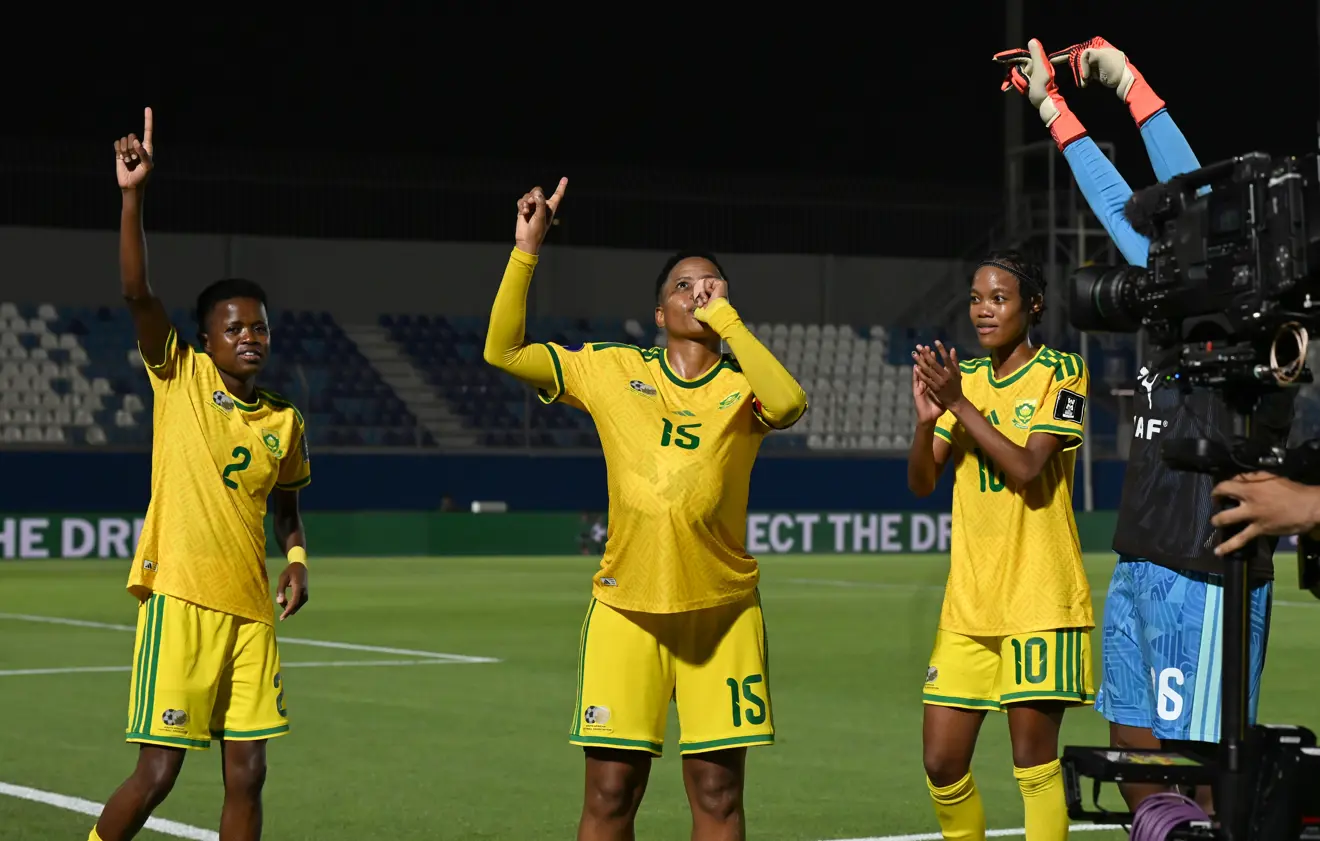
South Africa have ended Nigeria’s remarkable run of qualifying for every FIFA Women’s World Cup after defeating the Super Falcons 2-1 in their WAFCON 2026 playoff in Casablanca.
The result at the Stade Moulay Rachid sends Banyana Banyana into the inter-confederation playoffs for the 2027 FIFA Women’s World Cup in Brazil, while Nigeria’s hopes of reaching the tournament have come to an end.
It is a painful conclusion to a tournament that began with the Super Falcons seeking to defend their WAFCON title but ended with Nigeria suffering their earliest ever exit from the competition and missing the Women’s World Cup for the first time.
Both teams had entered the playoff after losing their quarterfinal matches, with Nigeria beaten 1-0 by Cameroon and South Africa suffering a 2-1 defeat to hosts Morocco. With only the winner guaranteed another opportunity to pursue World Cup qualification, the Casablanca meeting carried enormous significance.
South Africa ultimately produced the more decisive performance when it mattered most.
South Africa strike after a cagey first half
The opening half was about the pressure surrounding the contest, with neither team prepared to commit too many players forward.
South Africa created the first opportunity in the seventh minute when Linda Motlhalo attempted a long-range effort, although her shot sailed over the crossbar.
Nigeria responded three minutes later through Rasheedat Ajibade, whose effort from outside the penalty area drifted wide.
The Super Falcons attempted to establish control through possession, but South Africa remained organised and looked dangerous whenever they were able to transition quickly into attack.
Neither side could find the breakthrough before the interval, leaving the match delicately poised at half-time.
The deadlock was finally broken in the 56th minute when South Africa launched a swift counterattack. Hildah Magaia supplied the final pass for Thembi Kgatlana, who kept her composure to finish and put Banyana Banyana 1-0 ahead.
Kgatlana almost doubled the advantage shortly afterwards, but her close range attempt went wide.
Nigeria needed a response and came close in the 75th minute when Uchenna Kanu connected with a cross, only for Kaylin Swart to produce an important save and deny the Super Falcons an equalizer.
Jane doubles South Africa’s advantage
Swart’s interventions were crucial because South Africa doubled their lead only a minute later.
Refiloe Jane reacted quickest to a loose ball inside the penalty area and fired through a crowded box to make it 2-0.
The goal left Nigeria facing the prospect of missing the World Cup for the first time in their history, and the Super Falcons responded by committing more players forward.
Their pressure eventually produced a late opportunity after a VAR review resulted in Nigeria being awarded a penalty for handball against Jane.
The South African captain received a second yellow card and was sent off, while Christy Ucheibe stepped up to convert from the spot and reduce the deficit to 2-1.
Nigeria pushed desperately for an equaliser in the closing moments, but South Africa held firm to secure a memorable victory.
Nigeria’s historic World Cup record ends
The defeat brings an extraordinary record to an end. Nigeria had qualified for every previous edition of the FIFA Women’s World Cup since the inaugural tournament in 1991, making the Super Falcons the only African team to have maintained such a sequence.
That run will now end in 2027. The result also confirms Nigeria’s worst ever finish at the WAFCON. Before this tournament, the Super Falcons had never been eliminated in the quarterfinals and had always reached at least the semi final stage when they participated.
After losing to Malawi in their opening group match, Nigeria recovered with victories over Zambia and Egypt before the campaign unraveled with consecutive defeats to Cameroon and South Africa.
The loss to Cameroon ended their hopes of automatically qualifying for the World Cup, while Thursday’s defeat removed their final route through the inter-confederation playoffs.
READMORE: WAFCON 2026: Ghana fight back from early setback to keep 2027 World Cup dream alive
The result is likely to intensify scrutiny of the Super Falcons’ preparation and technical direction.
Nigeria’s build-up to the tournament was disrupted by the cancellation of a planned WAFU B tournament, while a proposed friendly against Ghana in Casablanca was also called off.
The NFF eventually arranged a double-header against Senegal in June, but there were also delays in the arrival of some players in Morocco.
Those circumstances do not fully explain Nigeria’s performances, but they will form part of the wider assessment of a campaign in which the defending champions struggled to turn possession and attacking talent into consistent results.
Head coach Justin Madugu will also face questions after the Super Falcons failed to score in their quarterfinal against Cameroon despite registering 19 attempts and nine shots on target, before struggling again to break down South Africa until the late penalty.
CLICK HERE TO JOIN ATHLETIC NG WHATSAPP CHANNEL NOW!
Banyana Banyana had been knocked out of the WAFCON title race by Morocco but have now secured another route towards Brazil 2027.
Their next challenge will come in the inter-confederation playoffs, where they will compete for one of the remaining places at the World Cup.
The victory also ignited the growing rivalry between the two nations. South Africa had already defeated Nigeria at the 2018 and 2022 WAFCONs, but Thursday’s result carries greater significance because it came in a World Cup qualification playoff.
For the first time, Banyana Banyana have defeated Nigeria in a World Cup qualifying or playoff match.
Meanwhile, the consequences are historic for Nigeria. The Super Falcons will not be at the 2027 FIFA Women’s World Cup, ending a sequence that had stood since 1991 and bringing an unexpectedly early conclusion to their WAFCON campaign.