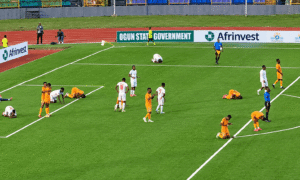
Nigeria’s failure to qualify for the 2027 FIFA Women’s World Cup has brought an extraordinary record to an end, but the Super Falcons’ absence from Brazil is also forcing a deeper examination of how the country has managed its women’s football programme.
South Africa’s 2-1 victory over Nigeria in Casablanca on Thursday ended the Super Falcons’ hopes of reaching the tournament for the first time since the Women’s World Cup began in 1991. For a country that has won a record 10 Women’s Africa Cup of Nations titles, the setback is difficult to view as simply another disappointing result.
It has also revived concerns raised by former Super Falcons head coach Randy Waldrum, who warned during his time in Nigeria that the country could no longer rely on its history and natural talent while other African nations were investing heavily in their football structures.
Waldrum warned Nigeria about the changing landscape
Waldrum, who spent four years in charge of the Super Falcons, had argued for a long term development plan that would strengthen Nigeria’s pathway from youth football to the senior national team.
He specifically pointed to the progress being made by countries such as Morocco and South Africa and warned that their investment would eventually reduce Nigeria’s traditional advantage.
“If you go to Morocco and look at their national training centre, it’s one of the best in the World,” Waldrum said in an interview last year.
He also warned against assuming that Nigeria’s dominance of African women’s football would continue simply because of its history.
“Other countries are beginning to invest and put more into football and eventually, it will catch up with Nigeria,” he said.
That warning now carries greater significance after Nigeria were eliminated by South Africa in a match that would have been difficult to imagine as a World Cup survival fixture a generation ago.
Nigeria’s advantage is no longer guaranteed
The Super Falcons still possess considerable individual quality, while Nigerian players continue to feature prominently in professional leagues around the world. The problem is that the strength of the country’s talent pool has not always translated into consistent performances from the national team.
South Africa have demonstrated how quickly that gap can narrow. Banyana Banyana have developed into a major force in African women’s football, winning the 2022 WAFCON and now defeating Nigeria at a crucial stage of the World Cup qualification pathway.
READMORE: South Africa end Nigeria’s 35-year World Cup run with hard-fought victory in Casablanca
Morocco have also invested significantly in women’s football and infrastructure, while other nations are becoming increasingly competitive against Nigeria.
The recent WAFCON campaign illustrated that changing landscape. Nigeria suffered a surprise 3-2 defeat to Malawi in their opening match, recovered with victories over Zambia and Egypt, but were then eliminated by Cameroon in the quarterfinals before South Africa ended their remaining World Cup hopes.
The Super Falcons therefore leave Morocco without a semi final appearance and, more significantly, without a place at the next Women’s World Cup.
The NFF will face difficult questions
The result inevitably places the Nigeria Football Federation under greater scrutiny, particularly with the federation’s September 2026 elections approaching.
The Super Eagles have already missed the 2026 FIFA World Cup, while the Flying Eagles recently lost 4-1 to Burkina Faso in the WAFU B U20 final and missed the qualification route to the 2027 U20 Africa Cup of Nations and World Cup.
There have also been recent setbacks involving the Golden Eaglets, although Nigeria’s women’s youth teams continue to provide reasons for optimism. The Falconets have qualified for the 2026 FIFA U20 Women’s World Cup, maintaining their record of appearing at every edition, while the Flamingos have also secured qualification for the 2026 U17 Women’s World Cup.
READMORE: ‘I don’t have any pressure’ – NFF President breaks silence on mounting scrutiny
That contrast raises an important question for Nigerian football: if the country continues to produce talented players and successful youth teams in certain categories, why has it become increasingly difficult to achieve consistent results at senior level?
The answer cannot rest entirely on one coach or one tournament. Preparation, technical planning, player development, infrastructure and administration all form part of the wider picture.
A failure that should force long term thinking
The NFF has defended its preparation of the Super Falcons, with President Ibrahim Musa Gusau insisting that the federation did its best to organise suitable opposition and prepare the team for the WAFCON.
But Nigeria’s historic World Cup qualification record has now ended, and the defeat to South Africa provides a clear opportunity to examine whether the structures supporting the national team are keeping pace with the progress being made elsewhere in Africa.
Waldrum’s warning was not that Nigeria would suddenly lose its talent. It was that other countries would continue investing until Nigeria’s traditional advantages were no longer enough.
South Africa’s victory in Casablanca has provided perhaps the clearest evidence yet that this process is already underway.
CLICK HERE TO JOIN ATHLETIC NG WHATSAPP CHANNEL NOW!
Nigeria remains one of Africa’s great football nations, with an enormous talent pool and a proud history in the women’s game. The challenge now is to ensure that history becomes the foundation for a stronger future rather than an excuse for assuming that success will continue to arrive automatically.
The Super Falcons’ absence from Brazil 2027 should therefore be treated as more than a painful tournament failure. It should be a warning that Nigeria must build the structures capable of turning its abundant talent into sustained success before the gap with its increasingly ambitious African rivals becomes even wider.