Plans to make the 2030 FIFA World Cup a landmark edition have sparked a debate among football’s leading authorities, with a proposal to take the tournament beyond its newly expanded format attracting growing attention.
The idea was initially welcomed as an opportunity to make the competition’s centenary edition even more historic. However, it has encountered resistance from several influential figures in world football, raising questions about whether FIFA would be willing to take the proposal further.
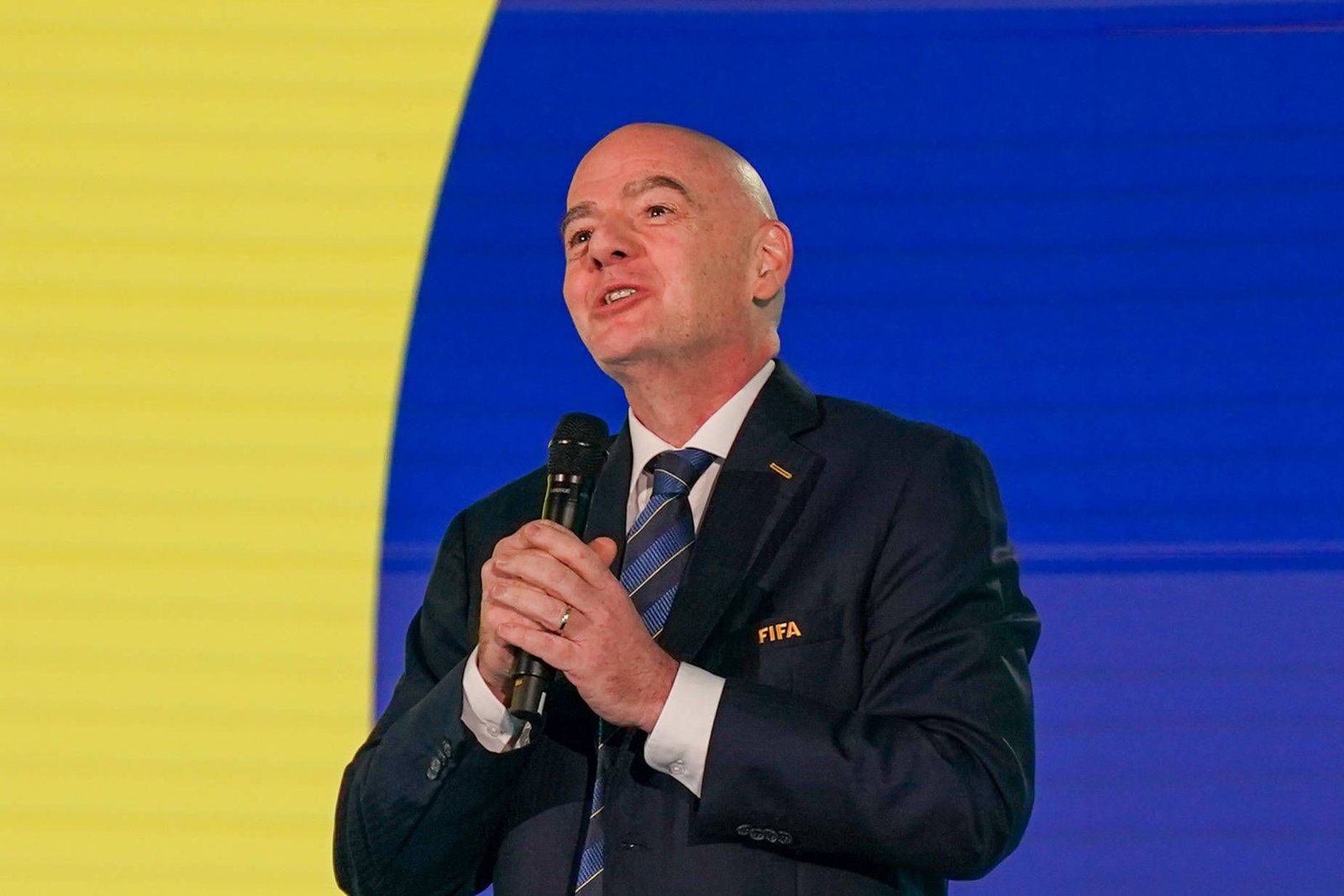
Now, a fresh report by The Times suggests that Gianni Infantino may have had a change of heart.
The FIFA president has reportedly told the leaders of the six continental confederations that he would not pursue further expansion of the men’s World Cup or the Club World Cup if he is re-elected in March 2027.
The development represents a shift from his position in July, when he said the proposal was worth examining after the 2026 World Cup.
The plan, championed by South America’s football governing body CONMEBOL, would have increased the number of participating countries at the 2030 tournament from 48 to 64.
How the 64-team proposal emerged
The idea was formally proposed by the South American Football Confederation (CONMEBOL) in April 2025.
Its president, Alejandro Domínguez, argued that expanding the tournament would make the centenary edition unique and allow more countries to participate in the celebrations.
The 2030 World Cup will be hosted principally by Spain, Portugal and Morocco, with Argentina, Uruguay and Paraguay staging opening matches to commemorate the first tournament, held in Uruguay in 1930.
CONMEBOL’s proposal would have increased the number of participating nations from 48 to 64, creating a one-off expansion for the centenary edition.
Infantino had previously supported examining the idea
Although the proposal initially faced resistance, Infantino later indicated that FIFA was willing to consider it.
In July 2026, during an interview with Swiss media outlet Bluewin, he said expanding the tournament to 64 teams could make sense and should be examined after the 2026 World Cup.
He argued that the competition should provide opportunities for more countries around the world, particularly those that have historically struggled to qualify.
His comments came after FIFA introduced the 48-team format for the 2026 tournament in the United States, Canada and Mexico, expanding the competition from its previous 32-team structure.
FIFA subsequently began examining the potential consequences of another expansion. A document seen by Reuters in July indicated that the governing body was seeking an independent agency to assess the impact of moving from 48 to 64 participating teams.
The proposed assessment was expected to consider whether the change could generate additional value for the tournament while examining concerns about competition quality, scheduling, operational demands and commercial sustainability.
Opposition grew around the proposal
The idea did not receive universal support, including from within South America, whose governing body had championed the expansion.
UEFA president Aleksander Ceferin publicly described the proposal as a bad idea, while Asian Football Confederation president Sheikh Salman bin Ibrahim Al Khalifa warned that allowing another expansion could create uncertainty over the tournament’s future format.
CONCACAF president Victor Montagliani also opposed the proposal, arguing that the 48-team format had not even been tested at the time the debate began.
There was also resistance within CONMEBOL itself. A report by The Guardian in October 2025 indicated that seven of the confederation’s 10 member associations did not support the expansion, with concerns about its effect on South American World Cup qualifying among the reasons.
READ MORE: Rangers-Kwara United refereeing controversy leads to indefinite NFF suspension
The latest report from The Times suggests that Infantino’s decision to step back from expansion is connected to the wider pressure surrounding his FIFA presidency and his expected re-election campaign.
The newspaper reports that the FIFA president has also abandoned plans to expand the Club World Cup beyond its current 32-team format and make the competition more frequent.
According to Finance Football, which also reported the development, the change comes amid criticism of a proposed arrangement involving private investors and the commercial rights to FIFA competitions.
Infantino is expected to face Japanese Football Association honorary president Kozo Tashima in the March 2027 FIFA presidential election, with another candidate backed by UEFA also potentially entering the contest.