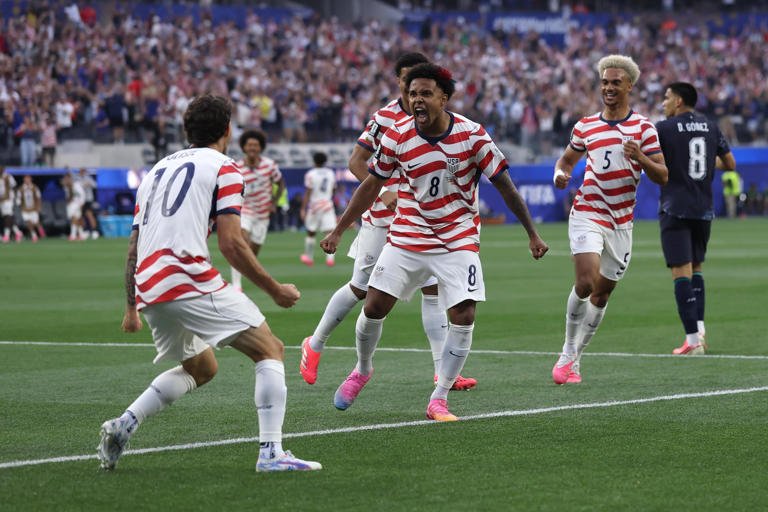
The race for top spot in Group D could take a significant turn at Lumen Field in Seattle, Washington on Friday, June 19, with kick-off scheduled for 8pm local time (4am Saturday in Nigeria). Both the United States and Australia opened their 2026 FIFA World Cup campaigns with eye-catching victories, transforming what initially looked like a routine group-stage fixture into one of the most intriguing contests of matchday two.
Why this match matters
Victory would leave either nation in a commanding position heading into the final round of group fixtures and potentially place one foot in the knockout stages. For the United States, it would also represent a historic achievement. The Americans have not won consecutive World Cup matches since the inaugural tournament in 1930, and another three points would guarantee multiple victories at a single World Cup for the first time since their quarter-final run in 2002.
Australia’s ambitions are equally significant.
The Socceroos arrived in North America with modest expectations after an inconsistent build-up, only to produce one of the surprises of the opening round by defeating Turkey 2-0. Another victory would not only strengthen their qualification hopes but also cement their status as one of the tournament’s early overachievers.
Group D was expected to revolve around the United States. Australia have given themselves an opportunity to rewrite that narrative.
Current form
Few teams made a louder statement on opening day than Mauricio Pochettino’s side.
The United States dismantled Paraguay 4-1, scoring four goals in a World Cup match for the first time in their history. Folarin Balogun announced himself on the global stage with a brilliant brace, Giovanni Reyna added late gloss, and the Americans displayed the kind of attacking fluency many believed they had been missing in recent years.
The victory continued a promising upward trend under Pochettino. The USA entered the tournament after encouraging performances against Senegal and Germany and now appear to be embracing the Argentine coach’s aggressive, front-foot philosophy.
Australia’s victory may have been less dominant statistically, but it was arguably just as impressive.
Tony Popovic’s men spent much of their encounter against Turkey under pressure, conceding 72 percent possession and facing 30 shots. Yet they emerged with a 2-0 victory thanks to clinical finishing, disciplined defending and an outstanding goalkeeping display from Patrick Beach.
The result highlighted the qualities that have often defined successful Australian sides: resilience, organisation and an ability to punish opponents in transition.
Historical context
Despite both nations being regular World Cup participants over the past two decades, meetings between them have been rare.
This will be the first World Cup encounter between the United States and Australia, with all four previous meetings coming in friendly matches.
The Americans hold the recent advantage, having won each of the last two meetings, including a 2-1 victory in October 2025.
History also presents an opportunity for the hosts.
The United States have not recorded back-to-back victories at a World Cup since 1930, a remarkable statistic given the nation’s growth on the international stage. Australia, meanwhile, are seeking successive wins at the tournament after claiming their first opening-match victory at a World Cup since 2006.
Key battle: Folarin Balogun vs Harry Souttar
One of the tournament’s most in-form forwards will face one of its most imposing defenders.
Balogun’s two goals against Paraguay took his international tally to 11 goals in just 28 appearances since switching allegiance to the United States. His movement between defensive lines, ability to attack space and growing confidence make him the focal point of the American attack.
Australia’s hopes of containing him may rest heavily on Harry Souttar.
The towering centre-back remains the leader of the Socceroos’ back line and will be tasked with winning physical duels while organising a defence expected to spend long periods without possession.
If Balogun finds room, the United States could flourish. If Souttar succeeds in limiting his influence, Australia’s chances rise considerably.
Tactical angle
The tactical contrast between these teams is one of the most fascinating elements of the contest.
Pochettino’s United States thrive on intensity. Their aggressive pressing structure forces turnovers high up the pitch before quickly transitioning into attack through players such as Balogun, Reyna and Christian Pulisic. Against Paraguay, that approach overwhelmed opponents who struggled to cope with the Americans’ speed and directness.
Australia are comfortable embracing a different reality.
The Socceroos allowed Turkey to dominate possession before ruthlessly exploiting spaces on the counterattack. Nestory Irankunda’s pace and direct running provide a constant outlet, while Connor Metcalfe and Jackson Irvine offer energy and discipline behind him.
The battle may ultimately be decided in transition. If the USA can sustain pressure and pin Australia deep, the hosts will create opportunities. If Australia can bypass the American press and release Irankunda into open space, they possess the tools to punish even the smallest defensive mistake.
Predicted lineups and team news
The major talking point for the United States centres on Christian Pulisic.
The AC Milan star has trained separately during the week after suffering a calf issue against Paraguay and remains a slight doubt. However, both Pochettino and captain Tyler Adams have expressed confidence that he will be available.
The remainder of the squad appears healthy, and the USA are expected to remain largely unchanged following their impressive opening victory.
USA (3-4-2-1):
Freese; Freeman, Richards, Ream; Dest, Adams, Tillman, Robinson; McKennie, Pulisic; Balogun.
Australia have no major injury concerns, although striker Mohamed Touré has been managing a fitness issue and faces a late assessment.
Goalkeeper Patrick Beach is expected to retain his place after a sensational World Cup debut against Turkey, while Popovic is likely to reward the side that produced one of the tournament’s biggest surprises.
Australia (3-4-2-1):
Beach; Circati, Souttar, Burgess; Italiano, O’Neill, Okon-Engstler, Bos; Metcalfe, Irankunda; Touré.
READMORE: ‘We deserved more’ – Broos insists Bafana were better side after Czechia stalemate
Numbers that matter
- The USA scored four goals in a World Cup match for the first time against Paraguay.
- The Americans have not won consecutive World Cup games since 1930.
- Eight of the USA’s last nine matches have seen both teams score.
- Seven of the USA’s last eight games have produced over 2.5 goals.
- Australia recorded their first opening-match World Cup victory since 2006 by beating Turkey.
- The Socceroos managed just 28 percent possession against Turkey but still won 2-0.
- Patrick Beach made eight saves on his World Cup debut.
- Nestory Irankunda is aiming to become the first player under 21 to score in his first two World Cup appearances since Memphis Depay in 2014.
- Australia have kept clean sheets in six of their last nine victories.
Final Verdict
The opening round offered encouraging evidence that both teams are capable of exceeding expectations.
The United States looked dynamic, confident and liberated under Pochettino. Australia demonstrated that organization and belief can still overcome superior possession and territory.
Seattle now provides a stage for both nations to prove that those performances were not isolated moments.
For the hosts, victory would signal genuine knockout-stage credentials. For Australia, another upset would transform them from surprise package into serious contenders for top spot in Group D.
AthleticNG Prediction: USA 2-1 Australia
Australia’s defensive discipline and counter-attacking threat should ensure a competitive contest, but the attacking quality of Balogun, Pulisic and Reyna gives the United States a slight edge. Expect the Socceroos to create problems in transition, but the hosts may ultimately possess too much firepower in front of their home crowd.