There is something increasingly uncomfortable about the story surrounding Ikorodu City’s first Lagos derby of the 2026/27 Nigeria Premier Football League season.
The match itself is straightforward enough. Sporting Lagos will host Ikorodu City at the Mobolaji Johnson Arena on Wednesday, September 30, after the fixture was moved from its original September 6 date because the venue had been billed to host a political activity for the ruling All Progressives Congress APC.
The Nigeria Premier Football League itself confirmed that the stadium was unavailable because it had been scheduled for the political activity.
But almost four weeks later, the football has become entangled in an entirely different conversation.
First came the postponement of what was supposed to be one of the most anticipated fixtures of the early NPFL season. Then came the controversy surrounding Ikorodu City’s deleted welcome post for Peter Obi when the former Anambra governor attended the club’s 2-0 victory over Enugu Rangers on Sunday.
And now, on the eve of the rescheduled derby, Ikorodu City has issued an unusual appeal to its supporters, asking them to turn up in numbers and provide their “maximum cooperation” before, during and after the game.
That sequence has left the club facing questions that go beyond what happens on the pitch.
A derby that had to give way to politics
When the Sporting Lagos-Ikorodu City fixture was originally postponed, the explanation was clear: Mobolaji Johnson Arena was unavailable because of a political activity involving the APC.
The NPFL announcement was unusually direct about the reason, stating that the venue was “billed to host a political activity for the country’s ruling party, the APC.”
The postponement angered supporters who had already bought tickets and made arrangements to attend. Reports at the time captured complaints from fans who had spent money on tickets, accommodation and other preparations for the game.
The significance was bigger than one rearranged fixture. The Lagos derby had been billed as a major moment for domestic football in a city that now has three clubs in the NPFL.
The league itself described the fixture as part of a new Lagos rivalry, while noting that the last topflight Lagos derby had been played a decade earlier.
So when football supporters were told that the stadium would instead host a political gathering, the obvious question was whether Nigerian football should continually have to make room when political activities require the same public sporting infrastructure.
That question is particularly important for the NPFL, a competition that is constantly trying to attract more supporters, improve its visibility and convince Nigerians that domestic football deserves their attention.
A derby that should have been about Sporting Lagos and Ikorodu City consequently became another reminder of how easily football can be pushed aside when other interests take priority.
Then came Peter Obi
Just when the derby controversy had begun to settle, Ikorodu City found itself at the centre of another football and politics debate.
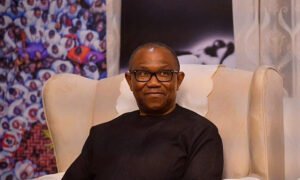
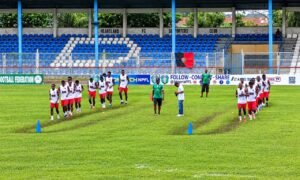
Peter Obi attended Ikorodu City’s home game against Enugu Rangers on Sunday. He watched from the VVIP section alongside club president Sanmi Doherty, while also being accompanied by Ladipo Johnson and Aisha Jimoh, both candidates of the National Democratic Congress. Ikorodu City subsequently defeated Rangers 2-0.
During the match, however, the club posted a message welcoming Obi to the stadium. It later deleted it.
The deleted message itself was innocuous on the surface: the club acknowledged Obi’s presence and welcomed him to Lagos.
But because Obi is an active presidential candidate ahead of the 2027 election, the deletion immediately created a political conversation around a football match.
The club’s director and photojournalist, Olawale Quadri, subsequently explained that Ikorodu City did not stop Obi from attending. Instead, he said the club removed the post because it wanted to stay away from politics, describing Obi’s appearance as a “political move”.
Readmore: Pre-Match: ‘It will not be easy’ – Chelle warns Super Eagles ahead of Guinea-Bissau clash
After the Rangers match, Obi highlighted another issue regarding the size of the crowd.
In his post after the game, he pointed to the poor attendance at a stadium with a capacity of roughly 10,000, arguing that Nigeria has the sporting talent but lacks the vision and commitment required to turn that talent into opportunities.
He also argued that sport should be treated as more than entertainment, pointing to its potential role in youth development, employment and social transformation.
That was followed by Ikorodu City’s latest message to supporters. The club thanked fans for their support since its establishment and then made an unusually direct appeal ahead of the Lagos derby.
“Your support and maximum cooperation are needed before the game, during the game, and ultimately after the game,” the club said.
It also urged supporters to maintain a high level of decorum, avoid confrontation and shun violence before asking them to come out in their colours and support the team.
On its own, there is nothing controversial about a football club asking supporters to fill its stadium.
In fact, that is exactly what clubs should want but the timing, however, makes the appeal impossible to separate from the conversation that followed Obi’s visit.
Ikorodu City had never needed to publicly plead with its supporters in this manner before, at least not in the circumstances now surrounding this derby. Now, after the attendance debate and the criticism that followed the deleted Obi post.
The club is asking Lagos football supporters to turn up and occupy the same stadium whose availability was previously sacrificed for a political event. That is the contradiction that deserves attention.
Football cannot keep living in politics’ shadow
The issue is not that politicians should be banned from football grounds.
Football belongs to everyone, including politicians, political candidates and public officials. Peter Obi has every right to attend an NPFL match as a spectator, just as any other member of the public does.
The issue is what happens when political activity begins to affect the football itself.
There is a fundamental difference between a politician attending a football match and a football match losing its venue because the venue has been allocated for political activity.
The first expands the audience around football while the second displaces football and and that distinction should not be lost.
For a league that desperately needs stronger attendance, better commercial value and greater public engagement, every opportunity to put football at the centre of the conversation matters.
The Sporting Lagos-Ikorodu City derby was not just another fixture. It was supposed to be the first topflight Lagos derby of the season and the first meeting between the two clubs at a time when Lagos has three teams in the NPFL.
Instead, political activity forced it off the original date. The fixture was eventually moved to September 30.
And now, with the game finally arriving, the discussion around Ikorodu City is once again being shaped by politics.
That is not necessarily because the club has chosen politics as its identity. In fact, its own explanation over the Peter Obi post was that it wanted to avoid political association, but the irony is difficult to ignore.
The club is trying to stay out of politics while operating in an environment where political activity has already affected its most important local fixture.
The supporters are not forgetting
The reaction to the latest appeal also shows that some supporters have not moved on from the earlier controversies.
Under the club’s appeal for fans to attend the derby, some commenters have continued to connect the postponement and the deleted Obi post.
Some sarcastically suggested that the club should invite APC supporters to fill the stadium. Others argued that the derby had lost some of its value after football was made to wait for a political event.
Those comments reveal the damage that can be done when football supporters begin to feel that their game is secondary.
The danger for Ikorodu City is not necessarily that fans will stay away. The club may well get a strong crowd on Wednesday. the bigger issue is the perception created around the fixture.
If supporters are being asked to fill the stadium after the stadium was previously unavailable for the derby because of a political event, they are entitled to ask what comes first when the interests of football and politics collide.
That is not an argument against political participation. It is an argument for protecting football spaces and football fixtures from becoming subordinate to political schedules.
LICK HERE TO JOIN ATHLETIC NG WHATSAPP CHANNEL NOW!
If Nigerian football wants to grow, the game needs spaces where football can simply be football.
Politicians can attend matches. Public figures can support clubs. Football clubs can welcome whoever comes through their gates.