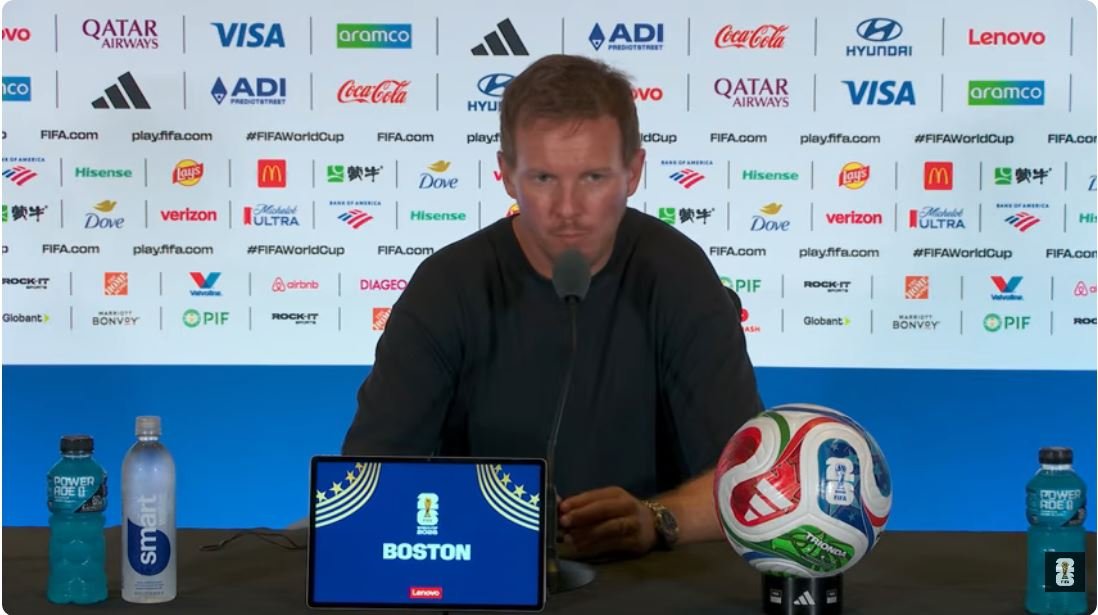
Julian Nagelsmann believes Germany can no longer claim to be among world football’s elite, delivering one of his starkest assessments yet after his side’s painful FIFA World Cup last-R32 exit to Paraguay.
Germany’s tournament ended in dramatic fashion after a 1-1 draw stretched into extra time before Paraguay triumphed 4-3 in the first penalty shootout of the 2026 World Cup knockout stage, extending a troubling run of disappointments on football’s biggest stage.
While refusing to hide behind statistics or excuses, Nagelsmann admitted the result reflected deeper issues that have plagued German football for more than a decade.
“I think it would be presumptuous to say we’re still at the top of world football,” the Germany coach told reporters after the defeat.
“It has now been three major tournaments with similar outcomes. We all tried different things, but the result has been very similar.”
Germany, four-time world champions, have endured a prolonged decline since lifting the trophy in Brazil in 2014, with another early exit reinforcing concerns about the direction of the national team.
READMORE: Morocco conquer penalty shootout to send the Netherlands back home
Nagelsmann pointed to structural shortcomings rather than isolated mistakes, suggesting Germany lacks enough players with specific profiles needed to compete consistently at the highest level.
“We don’t have 20 left-footed defenders,” he explained while highlighting the impact of injuries and the limited depth available in certain positions.
The coach also criticised his team’s performance against Paraguay, believing Germany failed to make their dominance count.
“Our build-up was far too slow,” he said. “We created too few dangerous situations with the quality and number of players we had. Against a team defending with such a compact block, we had to do much more.”
Despite acknowledging Paraguay’s disciplined defensive display, Nagelsmann insisted Germany should have produced far greater attacking threat and taken control long before the contest reached penalties.
Even so, he rejected the idea that the solution lies in quick fixes.
Instead, the 38-year-old argued Germany must embrace a longer rebuilding process built around its emerging generation, drawing comparisons with club football and recent international success stories.
“We have many talented young players, but they need time,” he said.
“If you make big changes, it takes time. You saw it with clubs like Manchester City and Liverpool. Spain also went through a period without winning before becoming successful again.”
CLICK HERE TO JOIN ATHLETIC NG WHATSAPP CHANNEL NOW!
Nagelsmann revealed that discussions have already begun about possible solutions for the future, although he acknowledged those decisions would ultimately rest with the German Football Association (DFB).