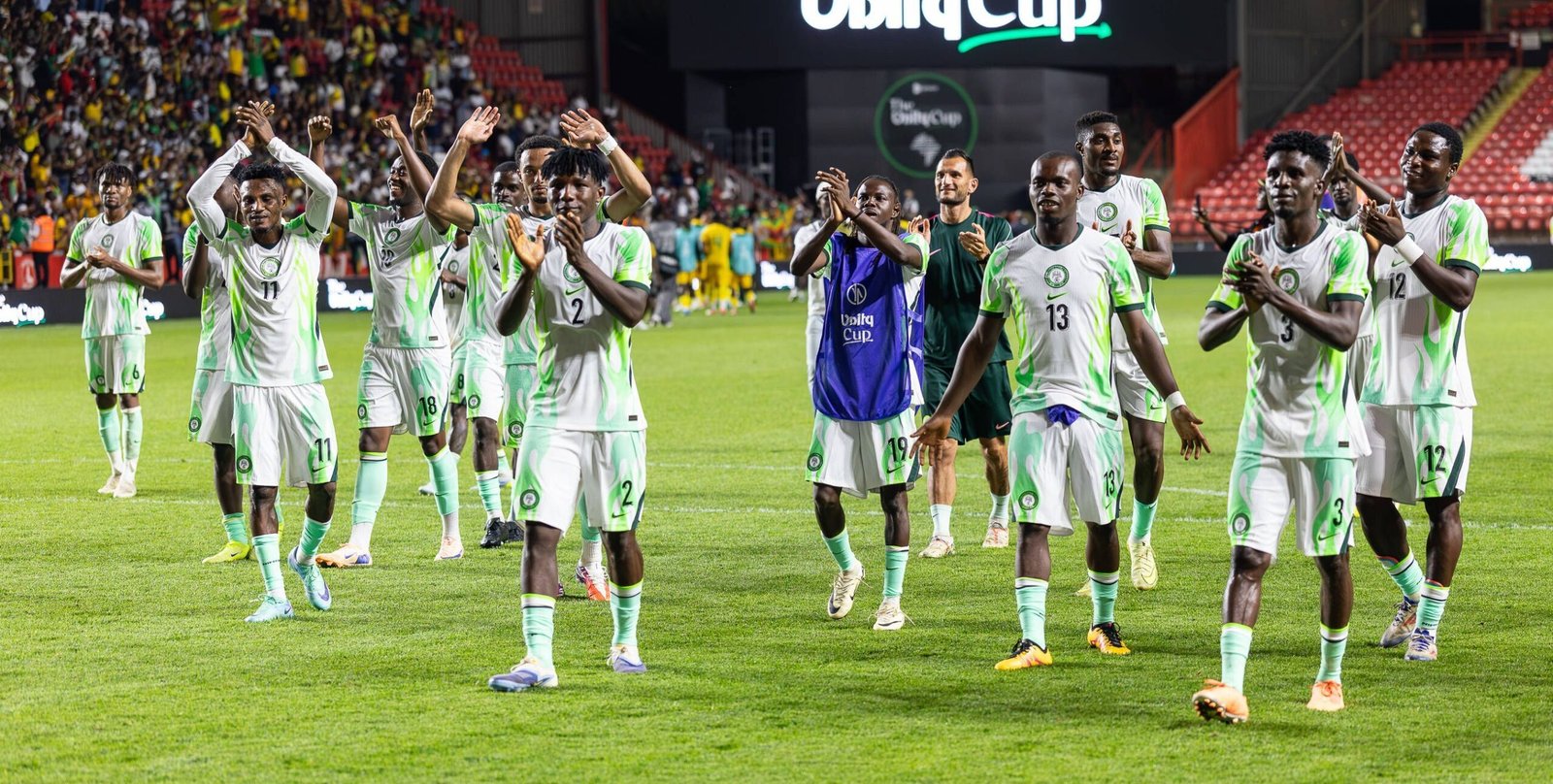
Nigeria’s Super Eagles and Jamaica will renew their growing rivalry on Saturday night when both nations meet in the final of the 2026 Unity Cup at The Valley in South-East London.
Far more than another end-of-season friendly, the match carries genuine significance. Officially recognised as a FIFA Tier 1 international fixture, the contest offers ranking points, another opportunity to assess emerging talent, and the chance to lift a trophy that has quickly evolved into one of the biggest celebrations of African and Caribbean football culture in the United Kingdom.
For Nigeria, it is also an opportunity to defend the title they won dramatically in 2025. The Super Eagles defeated Jamaica on penalties after a thrilling 2-2 draw in last year’s final at Brentford’s Gtech Community Stadium. Now, the two sides meet again with younger squads, fresh tactical identities and unfinished business.
Preview
Eric Chelle has used the Unity Cup as a rebuilding platform following a long club season for several senior stars. Established names such as Victor Osimhen, Ademola Lookman and Alex Iwobi were rested, allowing fringe players and home-based talents to stake their claim for future call-ups.
Millwall winger Femi Azeez exploded onto the international scene with a brilliant brace during Nigeria’s 2-0 semi-final victory over Zimbabwe on Tuesday. The 24-year-old now enters the final as one of the tournament’s breakout stars and perhaps Nigeria’s biggest attacking weapon.
Against Zimbabwe, Nigeria delivered a disciplined if occasionally inconsistent performance. The midfield trio of Samson Tijani, Tochukwu Nnadi and Alhassan Yusuf had mixed moments, while the defensive pairing of Igoh Ogbu and Chibuike Nwaiwu looked composed throughout most phases of the game.
READMORE: After Stanley Nwabali, another Nigerian leaves South African club as Super Eagles defender released
The Reggae Boyz booked their place in the final after beating India 2-0, courtesy of goals from Courtney Clarke and Charlton Athletic forward Kaheim Dixon. Dixon’s influence could be even greater in the final given the match will be played at his home stadium.
The Caribbean side looked sharp against India, pressing aggressively and attacking quickly through wide areas. Dixon’s movement and partnership with Bailey-Tye Cadamarteri repeatedly caused problems and could test Nigeria’s defence again.
Unlike last year’s final, this meeting promises to be more open. Both nations are fielding experimental squads and both managers appear keen to play front-foot football.
Head-to-head
Nigeria remain unbeaten in all three previous Unity Cup meetings against Jamaica.
The Super Eagles won their first encounter 1-0 in 2002 thanks to a James Obiorah strike before claiming a 2-0 victory at The Valley in 2004 through goals from John Utaka and Bartholomew Ogbeche.
Their rivalry intensified significantly in the 2025 Unity Cup final. Nigeria twice took the lead through Moses Simon and Samuel Chukwueze, but Jamaica responded both times through Kaheim Dixon and Jonathan Russell. After a dramatic 2-2 draw, the Super Eagles triumphed 5-4 on penalties.
Saturday’s showdown offers Nigeria the chance to claim a fourth Unity Cup title, while Jamaica are still chasing a first-ever victory over the Super Eagles in London.
Team news
Nigeria are expected to retain much of the side that defeated Zimbabwe, though Chelle could make a few changes as he continues to assess options.
Francis Uzoho is tipped to replace Arthur Okonkwo in goal, with the Omonia Nicosia goalkeeper likely to captain the side in Terem Moffi’s absence from the starting XI.
Igoh Ogbu and Chibuike Nwaiwu should continue in central defence, while Bruno Oputa and Elias Ochobi are expected to keep their places as adventurous full-backs.
Alhassan Yusuf remains key in midfield due to his experience, with Tochukwu Nnadi and Samson Tijani likely completing the trio.
In attack, Azeez has almost certainly earned another start after his match-winning display. Philip Otele is expected on the opposite flank, while Rafiu Durosinmi may lead the line ahead of Moffi.
Jamaica are also without several senior internationals, but interim coach Rudolph Speid has assembled an exciting youthful squad heavily influenced by England-based players.
Veteran defender Damion Lowe offers leadership at the back alongside Joel Latibeaudiere, while Isaac Hayden brings top-level experience in midfield.
The biggest danger remains Kaheim Dixon. The Charlton attacker scored against Nigeria in last year’s final and looked lively again against India. Playing at The Valley could provide an extra motivational edge.
The final is scheduled for Saturday, May 30, with kick-off set for 7:30pm BST (8:30pm Nigerian time). Before then, India and Zimbabwe will clash in Friday’s third-place play-off.